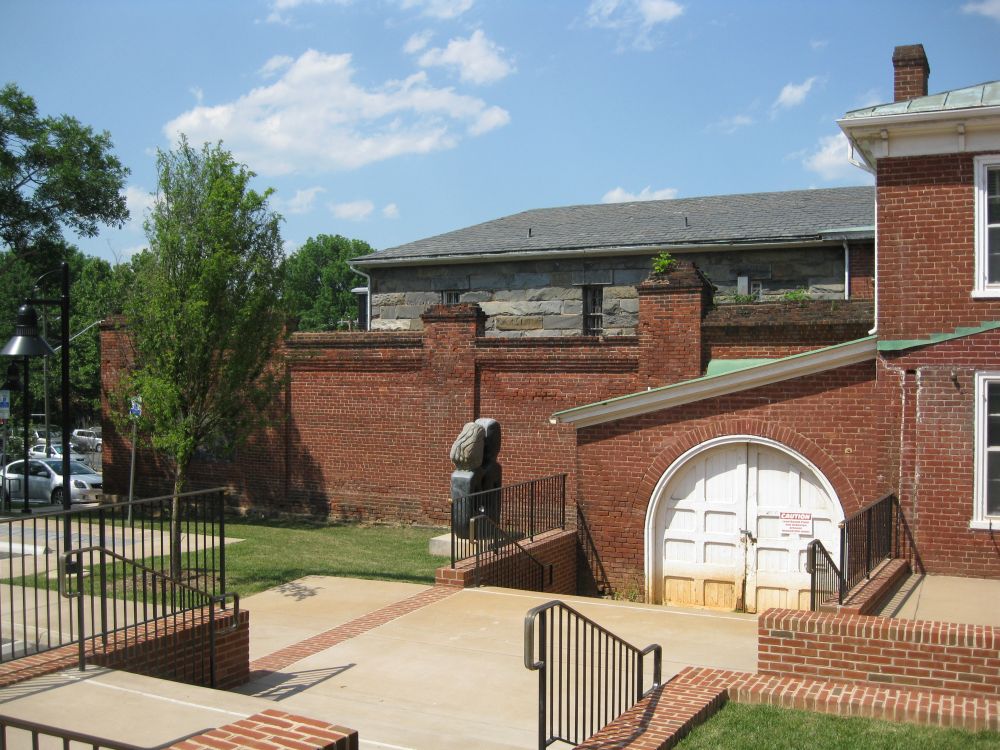
About This Location
A Romanesque Revival jail built in 1876 that operated until 1974. It was the site of Virginia's last public execution in 1908, when J. Samuel McCue was hanged for murdering his wife.
The Ghost Story
The Historic Albemarle County Jail stands as a forbidding monument to justice and death in Court Square, its three-foot-thick stone walls having witnessed nearly a century of incarceration and one of Virginia's most sensational executions.
Charlottesville architect G. Wallace Spooner designed and built the two-story stone structure in 1876, using stones salvaged from an earlier jail that had stood on Courthouse Square since 1749. The building measures just 20 by 68 feet, yet its tiny splayed windows covered with iron bars and extremely heavy doors made escape virtually impossible. Conditions inside were brutal: food was limited to one meal a day, and up to four prisoners shared each cramped cell. A brick annex and jail yard were added in 1880, followed by a jailer's residence in 1886, creating a complete picture of penitentiary evolution from the mid-nineteenth century into the twentieth.
The jail's darkest chapter centers on J. Samuel McCue, a prominent attorney who had served three terms as Charlottesville's mayor between 1896 and 1904. On September 4, 1904—just three days after leaving office—his wife Fannie Crawford McCue was found dead in the upstairs bathroom of their fashionable Park Street home. She had been strangled, clubbed, shot, and drowned in her bathtub, at a time when fewer than 14% of American homes even had one.
McCue claimed burglars had attacked them both, leaving him for dead on the bedroom floor. He even placed an advertisement in the Daily Progress offering a ,000 reward for information leading to his wife's killer. But police were suspicious. Testimonies from neighbors painted a turbulent picture of the marriage, with violent arguments and accusations of infidelity. Most damning were the words of McCue's teenage son, who described their home life as "a perfect hell on earth."
Within weeks, the former mayor was arrested and charged with first-degree murder. The trial became a national sensation, covered extensively by newspapers including the New York Times. McCue was convicted and sentenced to death by hanging.
On February 10, 1905, at 7:34 in the morning, J. Samuel McCue climbed the gallows in the jail yard. Before the trap door opened, three witnesses—George L. Petrie, Harry B. Lee, and John B. Turpin—signed a statement recording his confession: "J. Samuel McCue stated this morning in our presence and requested us to make public that he did not wish to leave this world with suspicion resting on any human being other than himself; that he alone is responsible for the deed, impelled to it by an evil power beyond his control; and that he recognized his sentence as just."
The execution was botched. The hangman had poorly positioned the knot, and McCue struggled and kicked for nineteen agonizing minutes before finally strangling to death at 7:53. His body was lowered at 8:00. It was the last legal execution to take place in Albemarle County.
The rope used to hang McCue now resides in the University of Virginia's Alderman Library archives. In December 1908, McCue's brother Harry had his body exhumed from the family burial grounds and reinterred in Riverview Cemetery—ironically, alongside the wife he had murdered.
The jail continued housing prisoners until 1974, when a new facility opened south of Charlottesville. Since then, the building has sat largely abandoned, used only for county storage. Efforts to convert it into a museum have repeatedly failed, with a 2014 proposal estimating million in costs.
Those who have entered the abandoned jail report an unmistakable presence. Visitors speak of an overwhelming chill upon crossing the threshold, as if the accumulated anguish of nearly a century of incarceration can be physically felt.
During the Charlottesville-Albemarle Historical Society's annual Spirit Walk—their biggest fundraiser—the jail becomes a staging ground for historical reenactments. One fall, an employee named Paul was stationed in the dark breezeway, playing the role of a jailer with only a lantern for light. Suddenly, he heard footsteps approaching. Assuming it was a tour group, he waited—but no one appeared. The footsteps continued, pacing the stone corridor, then faded into silence. Paul later learned this was not an isolated incident.
Tour guides and historical society members report that those phantom footsteps can be heard pacing the breezeway year-round, even when the building sits empty. Some believe it is the restless spirit of a long-dead jailer, eternally walking his rounds. Others suspect it is Samuel McCue himself, condemned to pace the same stones where he spent his final weeks—and his final, terrible nineteen minutes.
Whether the spirits are those of wrongly accused prisoners, vengeful felons, or the disgraced former mayor who confessed to being "impelled by an evil power beyond his control," the Old Albemarle Jail remains one of Charlottesville's most haunted landmarks. The horrors that defined this structure's past very much continue to haunt its present.
Researched from 9 verified sources including historical records, local archives, and paranormal research organizations. Learn about our research process.