About This Location
The largest stone fort ever built in the United States, constructed between 1819-1834. It imprisoned Jefferson Davis after the Civil War and was the site where enslaved people first landed in 1619.
The Ghost Story
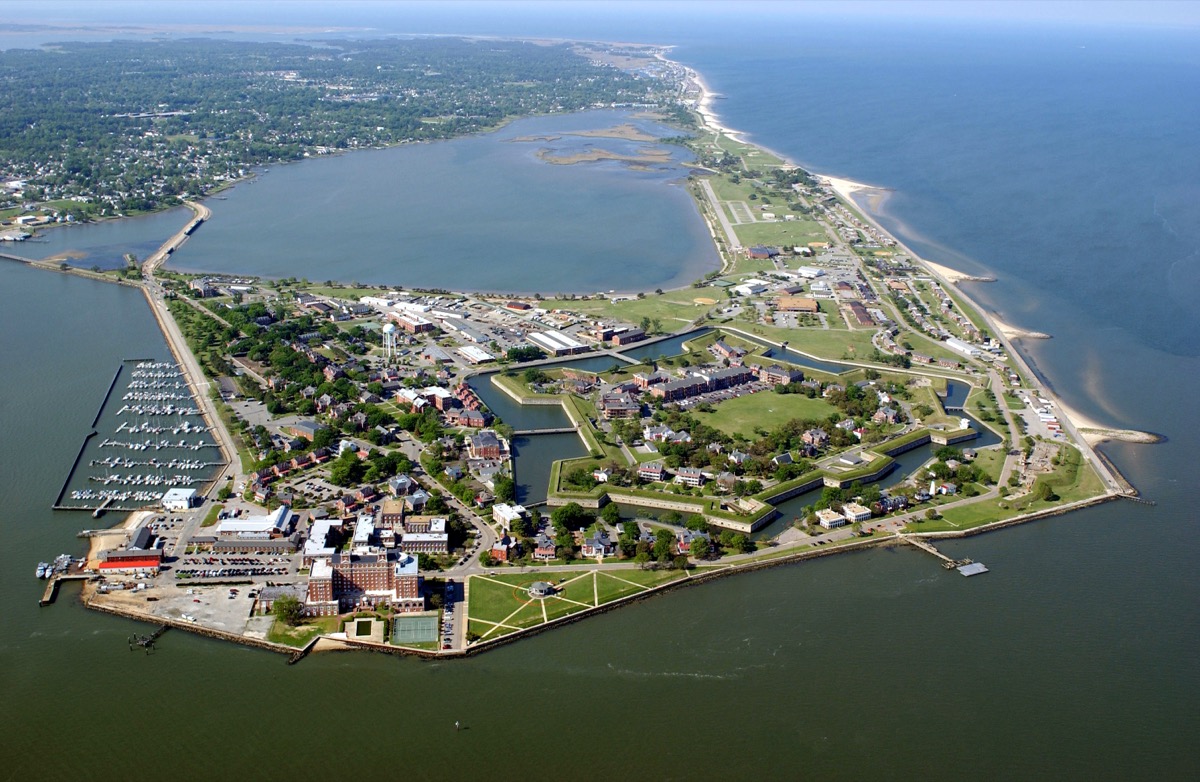
Fort Monroe rises from the waters of Chesapeake Bay as the largest stone fort ever built in the United States, an irregular hexagon completely surrounded by a moat that has been continuously occupied since 1823. Completed in 1834 as a peacetime garrison for 600 soldiers, it swelled to house 5,000 troops during the Civil War and remained one of only four Southern forts never captured by the Confederacy—earning its nickname "Freedom's Fortress" as thousands of formerly enslaved people sought refuge within its walls. With over 400 years of military history, the fort has accumulated an extraordinary concentration of spirits that the U.S. Army has officially recognized as haunted.
The most famous specter is the Lady in White, identified as Camille Kirtz, wife of a prominent businessman who lived on the fort grounds. While her husband traveled on business, Camille found love in another's arms—a young French soldier. Upon discovering them together, her husband flew into a rage and shot them both. The Frenchman survived; Camille did not. Her ghost now wanders the grove of oak trees along Ghost Alley on Matthews Lane, searching for her lost lover. "This is where the heaviest concentration of unexplainable tales takes place," notes Aaron Whittington, director of special events at the Fort Monroe Authority. Witnesses describe a cold breeze and soft crying when she appears in her flowing white nightdress, particularly near the chapel and moat.
Confederate President Jefferson Davis was imprisoned at Fort Monroe from May 25, 1865, until May 13, 1867, wrongly accused of plotting Abraham Lincoln's assassination. His first year was spent in a cramped cell in Casemate Number 2, where his health rapidly declined. His wife Varina rented quarters with a view of the casemate so she could watch his evening walks along the ramparts. Despite living another 24 years after his release, Davis's ghost is frequently seen walking those same ramparts at night—a tall, shadowy figure with chains rattling and footsteps echoing through empty halls. Varina's ghost appears in a second-story window across from the casemate, and witnesses report the window vibrating intensely when her presence manifests.
Quarters Number 1, the oldest and most ornate residence on post, hosts an extraordinary gathering of spirits. Abraham Lincoln, who visited in May 1862 to plan the attack on Norfolk, has been seen standing by the fireplace deep in thought. General Ulysses S. Grant and the Marquis de Lafayette have also been spotted reviewing papers—likely connected to troop movements and battles. Paranormal investigators recorded electronic voice phenomena of a little girl calling for her cat, "Greta," and workers in the building (now office space) regularly see a phantom gray cat disappearing around corners.
Edgar Allan Poe enlisted in the U.S. Army and served as sergeant major of artillery at Fort Monroe for four months in 1829, during which he wrote "The Cask of Amontillado"—a tale of a military man walled up in a stone building that mirrors his surroundings. His spirit frequents his former barracks and appears on the porch of the Chamberlin Hotel in a top hat. A young boy living in quarters above the Casemate Museum kept telling his mother about "the man in my closet." When they visited the museum, at eye level was a ghostly sketched image of Edgar Allan Poe. The boy immediately identified him.
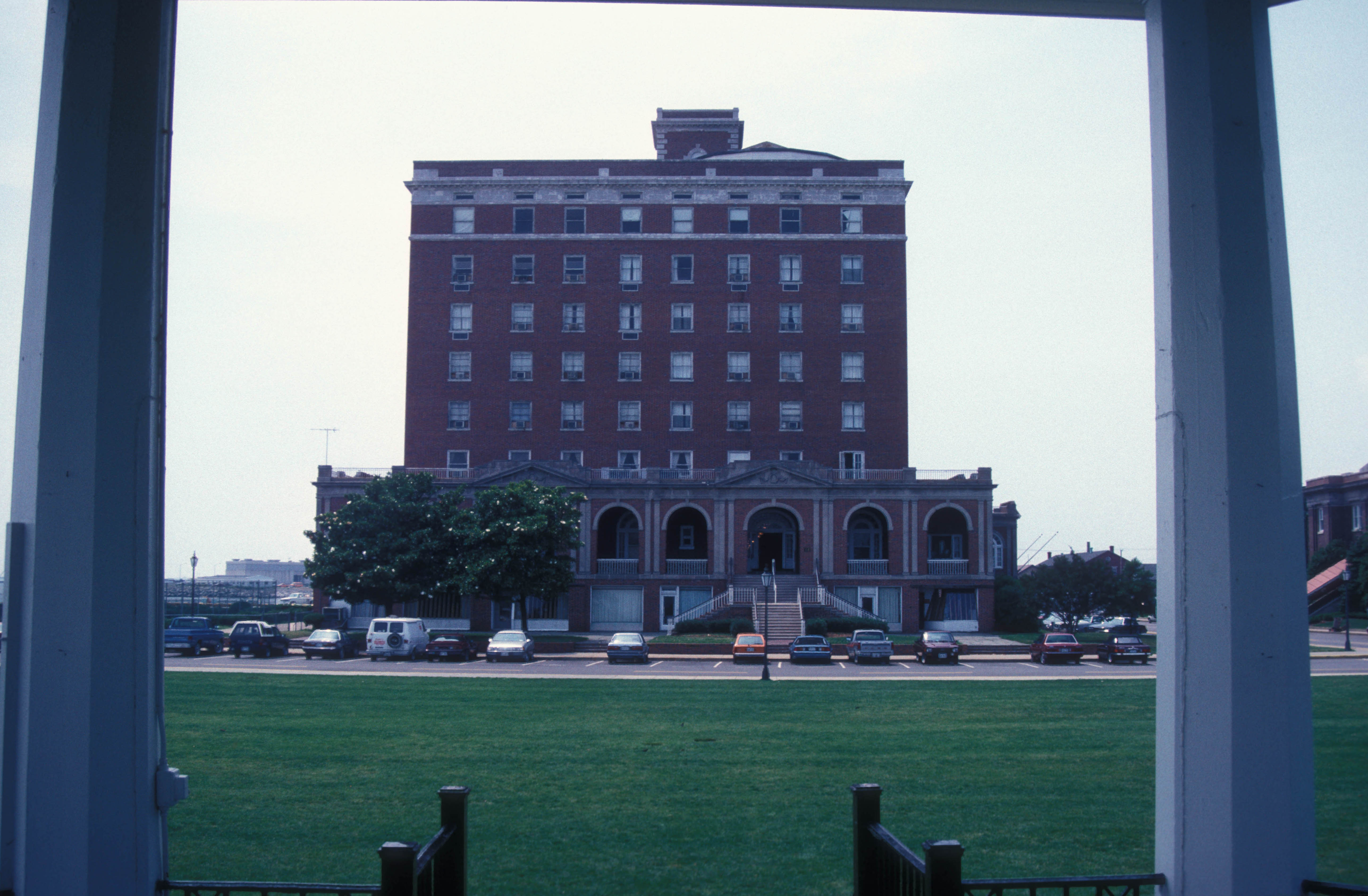
The Chamberlin Hotel itself harbors Esmeralda, a ship captain's daughter who haunts the eighth floor, eternally waiting for her father's return from sea. The haunting was so intense that the eighth floor was closed to guests, and Room 301 became so active it's now used only as daytime office space.
Jane Polonsky, who lived at Fort Monroe in the 1960s, documented dozens of accounts in her book "The Ghosts of Fort Monroe." Her own encounter came in her dining room when an arrogant-looking soldier in a mid-18th-century uniform materialized near the fireplace, one arm resting on the mantle. "I was stunned," she recalled. "He just looked at me very arrogantly and just disappeared, just like that." Her son reported a strange mist in his bedroom; decades later, the current resident reports the same phenomenon in the same room.
Paranormal investigators conducting tours at the fort have captured floating orbs in photographs, disembodied voices, and the distinct sound of horse hooves on the cobblestones. In the Old Slave Quarters, furniture moves on its own and objects fly through the air. Robert E. Lee's former residence experiences mysterious footsteps and voices. Battery-operated toys activate without batteries. Deputy Public Affairs Officer Heather McCann confessed to the Army press: "I've got to tell you guys, and I mean this. I don't come through here at night."
Recent residents describe a woman in a maroon Victorian-era dress tending an invisible crib in an upstairs dressing room. Two child spirits—one near the moat, another in a basement—attempt to interact with living visitors, particularly children. As one current resident observed: "Out of the corner of your eye you can catch sight of things and when you turn to look they're not there. It feels like this is a family dwelling and you very much feel at home here. There's no bad feeling to this house at all."
The Fort Monroe Authority now hosts annual ghost walks in October, and the Casemate Museum has become a focal point for paranormal activity. Security guards have encountered Confederate soldiers so vivid that one "freaked him out enough to spill his coffee on himself." Investigators recorded sounds from the embrasures and Postern Gate area. With over 150 historic buildings spread across 500 acres, Fort Monroe contains centuries of history—and an entire garrison of ghosts that refuse to stand down.
Researched from 10 verified sources including historical records, local archives, and paranormal research organizations. Learn about our research process.