About This Location
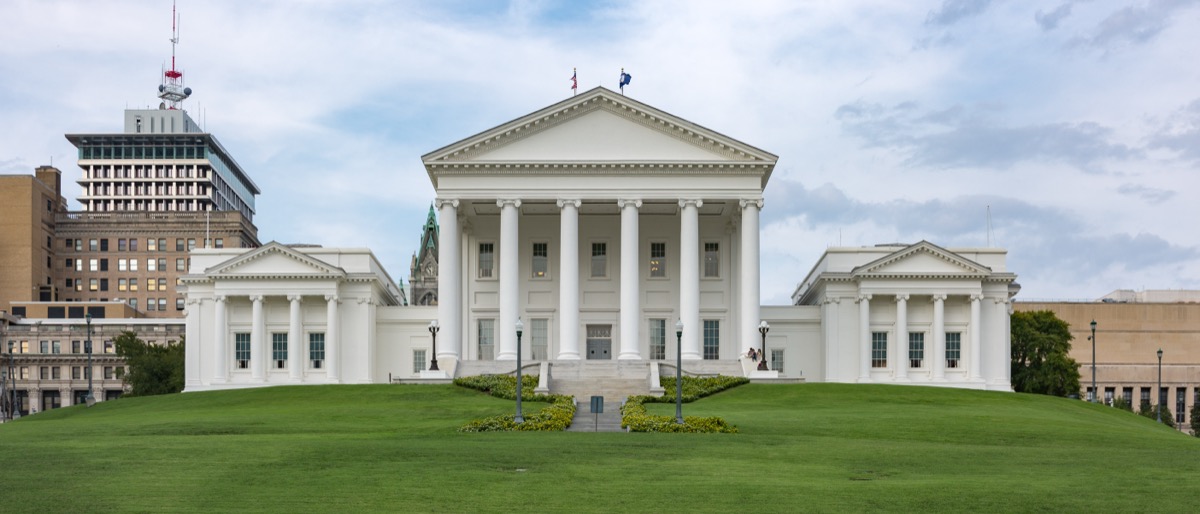
Designed by Thomas Jefferson and completed in 1788, it is the second-oldest working capitol building in the United States. The building witnessed the trial of Aaron Burr and served as the Confederate capitol.
The Ghost Story
The Virginia State Capitol, designed by Thomas Jefferson and Charles-Louis Clerisseau and modeled after the ancient Roman temple Maison Carree in Nimes, France, has witnessed over two centuries of American history since its completion in 1788. It served as the Confederate capitol during the Civil War and today houses Jean-Antoine Houdon's magnificent 1796 marble statue of George Washington in its grand rotunda. But this architectural masterpiece holds darker memories—particularly those of April 27, 1870, when one of Virginia's deadliest disasters occurred within its walls.
On that spring morning, hundreds of spectators crowded into a second-floor courtroom to witness the Virginia Supreme Court of Appeals ruling on a bitter mayoral dispute between Republican George Chahoon and Democrat Henry Ellyson—a proxy battle over Reconstruction-era authority. Just after 11 a.m., as the clerk entered with both mayors and their counsels present, a piece of ceiling fell. Then a girder supporting the spectator gallery gave way. The gallery crashed into the courtroom floor, which itself collapsed, sending the entire mass of humanity plummeting forty feet into the House of Delegates chamber below.
As one contemporary account described it: "The mass of human beings who were in attendance were sent, mingled with the bricks, mortar, splinters, beams, iron bars, desks, and chairs to the floor of the House of Delegates and in a second more, over fifty souls were launched into eternity!" The Richmond Dispatch reported the "HORRIBLE CALAMITY" the following day. In total, 62 people perished and 251 were injured.
Among the dead was Patrick Henry Aylett Jr., a respected Richmond attorney and great-grandson of Founding Father Patrick Henry. Before entering the courtroom that morning, he had remarked prophetically about his own death. Crushed beneath the debris, he "continued to talk of his wife until his spirit took its flight." Also killed was State Senator J.W.D. Bland, one of only two African Americans among the victims, and William Charters, Chief of the Richmond Fire Department. The youngest victim was John Turner, a 13-year-old House page.
For over a century, murmurs of paranormal activity have echoed through the Capitol's halls. L.B. Taylor Jr., Virginia's premier chronicler of the supernatural, was the first author to note that "some say the eerie cry of mournful voices, muted under tons of debris, can still be heard in the hallowed corridors of the Capitol." Pamela K. Kinney echoed these descriptions in her 2007 book "Haunted Richmond."
The most detailed documentation came from Paul Hope, a former Virginia Capitol Police officer who worked the graveyard shift patrolling the grounds and buildings at night. In his 2013 book "Policing the Paranormal: The Haunting of Virginia's State Capitol Complex," Hope revealed that paranormal activity occurred regularly within Capitol Square—experiences kept secret from the public until his publication.
Hope's own initiation came early in his training. Entering the magnificent rotunda housing Houdon's marble Washington, he and a senior officer proceeded to the Old House of Delegates Chamber—the very room where victims had fallen in 1870. A training officer encouraged Hope to read the memorial plaque commemorating the disaster. As the pair stood in silence, Hope observed a dark shadow move across the gallery above them before disappearing. The other officer witnessed it too. Scanning the gallery with flashlights revealed no living person. The room maintained a constant mysterious chill—so pronounced that doors were sometimes opened to cool other parts of the building during sweltering Southern summers.
Hope documented experiences throughout the Capitol complex. During patrols near the Old House Chamber, officers reported unexplainable moving shadows, disembodied voices, footsteps with no source, cold spots, and "the acute and unmistakable sensation of being in the presence of something unearthly." One of the most chilling accounts involved a female Capitol Police officer named Emma, who in 2003 encountered an apparition while using a sixth-floor vending machine. She saw a reflection approaching from behind—an elderly tall man with thick, scruffy curly brown hair, a short beard, and brown suit. Most disturbing was his unnatural gaze, eyes looking directly at her while his head tilted downward. An intense cold struck her neck. When she turned, no one was there. Emma was so terrified she refused to re-enter the building.
Hope himself experienced phenomena on the sixth floor. After making coffee in the kitchen, he spotted a shadow moving before him in the winding hallways. Then came the unmistakable scent of cigar smoke—though he was alone in the building. An overwhelming "chillingly cold static electricity charge" caused his body hair to stand on end. The cigar smell intensified as he approached the source, forcing him to retreat.
The adjacent Virginia Executive Mansion, home to governors since 1813, harbors its own famous specter. In the early 1890s, Governor Philip McKinney entered his bedroom and saw a young woman in a taffeta gown gazing out the window. When he asked his wife about the guest, she replied: "I have no guest." The ghost, known as the Lady in Taffeta, was later chased down a staircase by a brother of Governor Andrew Jackson Montague between 1902 and 1906. In summer 1973, Governor Linwood Holton reported paintings propped against his bedroom wall were found face-down on the carpet when he awoke—"There was no wind to move them—nothing." A ghostly butler has also been spotted between the Executive Mansion and Capitol, believed to be a former member of a governor's personal staff.
Perhaps the souls "launched into eternity" on that terrible April morning in 1870 never truly departed. The Old House of Delegates Chamber remains the epicenter of the haunting, its memorial plaque a testament to tragedy and its cold air a reminder that some spirits may still linger where they fell.
Researched from 10 verified sources including historical records, local archives, and paranormal research organizations. Learn about our research process.