About This Location
Originally the Little Rock Arsenal built in 1840, this Civil War-era building served as a Confederate and Union outpost and a hospital. It is also the birthplace of General Douglas MacArthur.
The Ghost Story
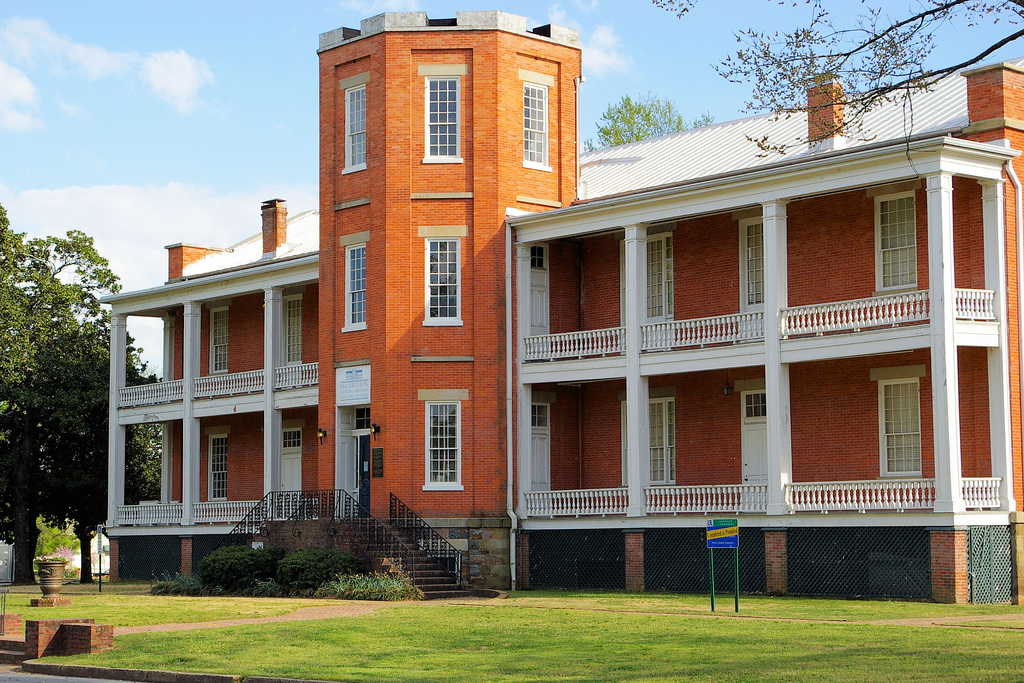
The Tower Building of the Little Rock Arsenal stands as the sole survivor of what was once a thirty-six-acre military complex containing more than thirty structures. Designed in 1840 by army engineer Richard B. Lee of Virginia, the two-story brick building features nearly three-foot-thick exterior walls built to store munitions, with a distinctive crenellated three-story octagonal tower rising from the center of its north facade. Construction used timbers from Pine Bluff, stone quarried from Big Rock on the north side of the Arkansas River, and locally made bricks. The arsenal was established at the request of Governor James S. Conway in 1836, the same year Arkansas achieved statehood, to defend the frontier against potential conflicts with Native Americans passing through the state. By the time the complex was complete, it had cost $30,000 -- more than double its original $14,000 budget.
The arsenal's most dramatic moment came in February 1861, when armed citizens threatened to seize the installation in anticipation of Arkansas's secession from the Union. Captain James Totten, the arsenal's commander, negotiated a peaceful surrender to state authorities rather than risk bloodshed. The women of Little Rock presented Totten with a ceremonial sword in recognition of his restraint. After Arkansas seceded in May 1861, Confederate forces used the arsenal until September 11, 1863, when Union troops under General Frederick Steele captured Little Rock. The building then served as housing for military families from 1863 through 1890. On January 26, 1880, Douglas MacArthur -- future five-star General of the Army and Supreme Commander of Allied Forces in the Pacific during World War II -- was born in the Tower Building while his father, Captain Arthur MacArthur, was stationed at the post. The arsenal was decommissioned on October 1, 1890, and in 1892 the federal government transferred the property to the City of Little Rock. All other arsenal buildings were demolished, leaving the Tower Building standing alone as the centerpiece of what became MacArthur Park.
The building's darkest association involves David Owen Dodd, the seventeen-year-old known as the Boy Martyr of the Confederacy. Born November 10, 1846 in Lavaca County, Texas, Dodd had moved with his family to Little Rock where he attended St. John's College. On December 29, 1863, while traveling back toward Confederate lines, Union sentries stopped Dodd at Ten Mile House on Stagecoach Road and discovered he lacked a pass. When asked for identification, Dodd produced a leather notebook containing his birth certificate -- and a page covered in Morse code dots and dashes that, when decoded by a telegraph-trained Union officer, revealed exact information about Union troop strength in Little Rock, including the positions and armaments of the 3rd Ohio Battery and 11th Ohio Battery. A military court-martial convicted him of espionage. General Frederick Steele allegedly offered repeatedly to spare the boy if he would reveal his intelligence source. According to legend, Dodd replied: "I can give my life for my country but I cannot betray a friend." On January 8, 1864, Dodd was hanged on the grounds of St. John's College near the arsenal before a crowd of two thousand citizens and a four-thousand-man military escort. Historical accounts dispute whether death came quickly or involved prolonged suffering, with some sources indicating the gallows were too low, causing slow strangulation rather than a clean break.
The Tower Building has accumulated a reputation as one of the most haunted buildings in Arkansas, with reports spanning well over a century. Staff and visitors have documented apparitions, shadow figures, disembodied voices, phantom music, and objects that move on their own. The most frequently reported phenomenon involves two shadow figures beneath the grand staircase in the basement, still reliving what appears to be a duel -- a confrontation between two soldiers believed to have occurred in the arsenal's early years. A playful entity attributed to David Owen Dodd throws objects at visitors from the right-hand staircase between the third and second floors, particularly during late afternoons and stormy weather. On the second floor, a solid figure of a man in a dark military uniform has been seen lying across theater chairs in the tower room; when an employee approached, the figure melted into thin air. A translucent apparition has been observed walking down the main staircase before vanishing. The entity known as "Sarge" -- a male presence concentrated on the tower's upper floor -- has been detected by multiple investigation teams. A woman and young child have been seen together, and a separate female spirit identified as "Katharine" is associated with the piano music sometimes heard emanating from the second-floor East Room.
Program coordinator Shane Lind described hearing distinct footsteps on the tower staircase after securing the building and turning off all lights, noting the old stairs produce a particular sound when walked upon. In 1996, a staff member working alone in the basement office heard music, laughter, and talking coming from the room directly above -- a room that was empty and locked. The smell of cigar smoke has been reported wafting up from the basement when no one occupied the building. Disembodied voices, talking, and music have been heard by both staff and visitors throughout the building.
The Spirit Seekers Paranormal Investigation Research and Intervention Team conducted a formal investigation on April 25, 2005, during which they contacted three distinct entities: Katharine, a male presence near the jeep display on the ground floor, and a protective male spirit. Their photographs captured orbs both inside and outside the museum. Arkansas Ghost Catchers co-founder Rhonda Burton, described as the most respected paranormal investigator in the Little Rock area, has conducted Ghost Hunting 101 classes at the museum, during which her FM sweep (Spirit Box) equipment captured EVP recordings including two-to-three-word spirit responses. The museum now hosts regular ghost hunting and investigation programs, and has served as the venue for the Arkansas Paranormal Expo, which featured keynote speakers on UFOs, cryptozoology, psychic phenomena, and paranormal investigation. The Tower Building was listed on the National Register of Historic Places on July 28, 1970 and designated a National Historic Landmark on April 19, 1994.
Researched from 11 verified sources including historical records, local archives, and paranormal research organizations. Learn about our research process.