About This Location
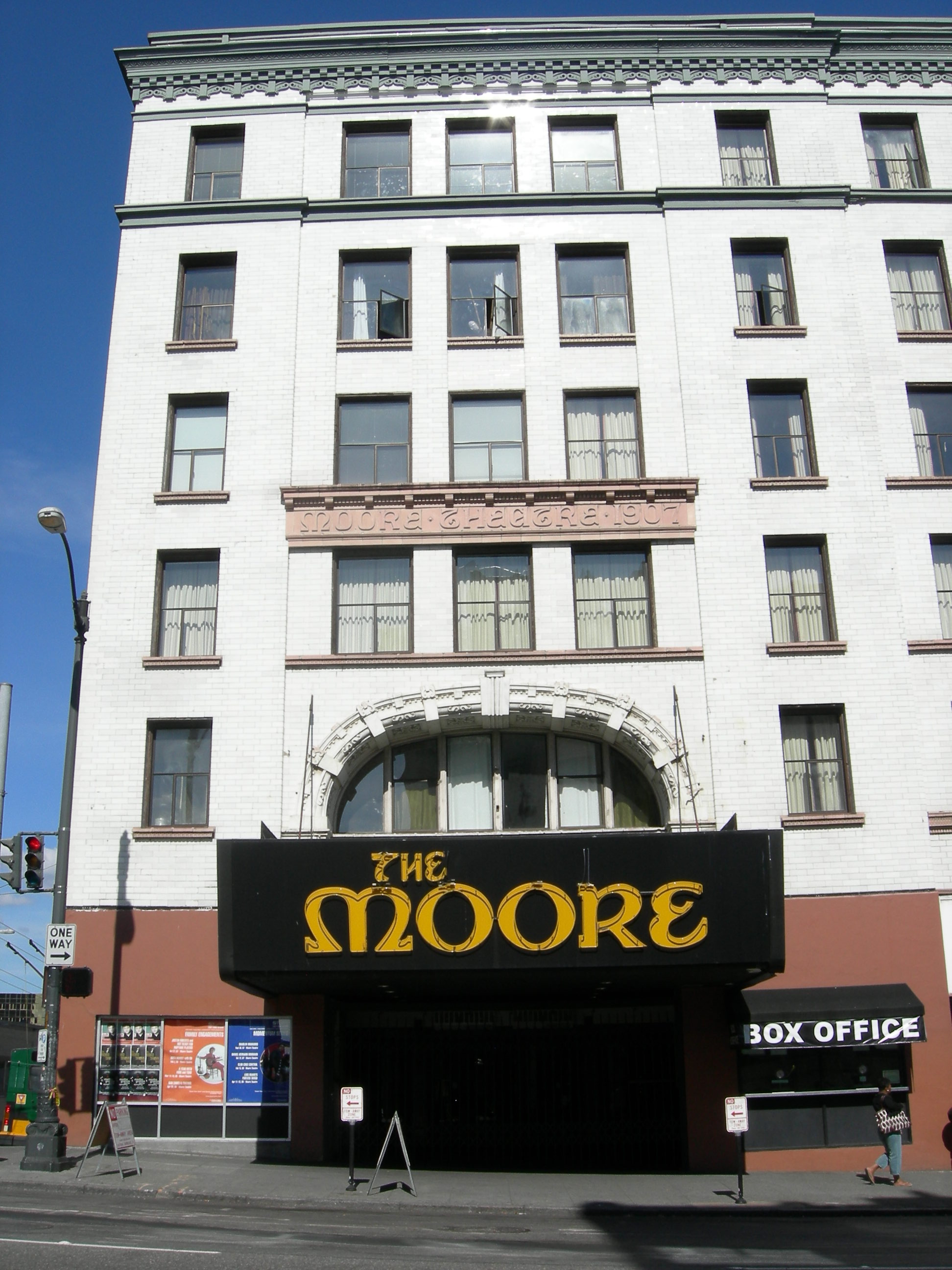
Seattle's oldest active theater, opened in 1907, an 1,800-seat venue built on the grounds of the city's first cemetery where not all bodies were relocated.
The Ghost Story
The Moore Theatre stands on ground that has held Seattle's dead since the city's founding. Pioneer settlers began burying their dead on this hillside near Second Avenue and Stewart Street as early as 1853, just two years after the Denny Party landed at Alki Point. About twenty souls were interred in what became Seattle's first cemetery before burials ceased around 1860. Most bodies were relocated to the municipal cemetery at what is now Denny Park, but the pioneers' grave markers were fragile wooden things that rotted and vanished in western Washington's perpetual damp. When builders broke ground for the nearby Denny Hotel in the 1890s, they unearthed remains they had not expected to find. In 1898, workers discovered two Indigenous graves containing burial goods, sparking a rush of treasure hunters to plunder whatever remained. Not all the dead were accounted for.
James A. Moore, a Nova Scotia-born real estate developer who had opened entire Seattle neighborhoods including Capitol Hill and the University District, commissioned architect E.W. Houghton to build his grand theater on this very ground after the Denny Regrade project destroyed his plans for the hilltop Washington Hotel. The Moore Theatre opened on December 28, 1907 with a performance of The Alaskan, a comic opera featuring falling snow, sled dogs, and thirteen singing totem poles. The theater cost approximately $350,000 and seated 2,436, its balcony suspended by a massive 22-ton steel girder that eliminated every obstructing support column. The lobby was the largest of any American theater at the time, with Mexican onyx wainscoting, brass fixtures, and a marble mosaic floor that alone cost $30,000. Moore turned management over to John Cort, who later became a prominent New York impresario. The theater also carried a darker architectural feature: a separate entrance on Virginia Street that funneled Black audience members directly to the worst seats in the second balcony, a segregated passage that still exists today as a physical reminder of the Jim Crow era.
The theater's paranormal reputation crystallized in the late 1970s, when owners Dan Ireland and Darryl MacDonald discovered several employees conducting a seance in the auditorium. The two had just placed the theater on the National Register of Historic Places in 1974 and renamed it the Moore Egyptian. They fired the participants on the spot, but the ritual was never formally closed. According to local paranormal researchers, the interrupted seance left something open. Reports of unexplained phenomena accelerated from that point forward.
Steve Martin, the theater's general manager since the mid-1990s, has described his own encounter to Seattle Refined. One morning around 9:30, alone in the basement production area, he heard distinct footsteps crossing the stage above him. He went upstairs to investigate and found no one. The footsteps repeated three times before Martin confronted the presence out loud, asking it to stop. It did. Martin's assessment: "If there are ghosts here, they're cool with our presence." Other staff members report the sound of something being dragged across the stage followed by deliberate footsteps, though the source is never found. The smell of cigar smoke wafts inexplicably from the seats, a phenomenon many attribute to Moore himself, who died debt-ridden in San Francisco in 1929 but may have never truly left his greatest creation. In February 2021, a concert attendee reported seeing a woman in a Victorian-style blue dress with small flowers walking purposefully toward a sectioned-off area before vanishing instantly, despite appearing completely solid moments before. Employees at the adjacent Moore Hotel have reported a shadowy man in a top hat who appears in guest rooms and kicks the foot of beds.
The TAPS team from Ghost Hunters investigated the Moore Theatre for Season 3, Episode 15, titled Ghostly Houseguest, bringing in local investigator Mike Dion given the building's enormous size. Investigator Dave captured an audio recording that sounded like the word "chestnut," and Jason noted a video showing an unexplained solid black mass that appeared to be a female figure. Despite these anomalies, TAPS ultimately determined they could not substantiate claims of paranormal activity. The theater's ghosts, it seems, perform on their own schedule.
The Moore Theatre remains Seattle's oldest active theater, its current 1,400 seats hosting everything from Pearl Jam concerts to the Seattle International Film Festival, which was born here in 1976. On June 9, 1989, Sub Pop Records staged the sold-out Lame Fest showcase with Nirvana, Mudhoney, and Tad, a night that helped launch the grunge movement. The spirits of the Moore, whoever they are, have witnessed over a century of Seattle's cultural history from vaudeville to grunge, and if the accounts are to be believed, they remain an attentive audience still.
Researched from 13 verified sources including historical records, local archives, and paranormal research organizations. Learn about our research process.