About This Location
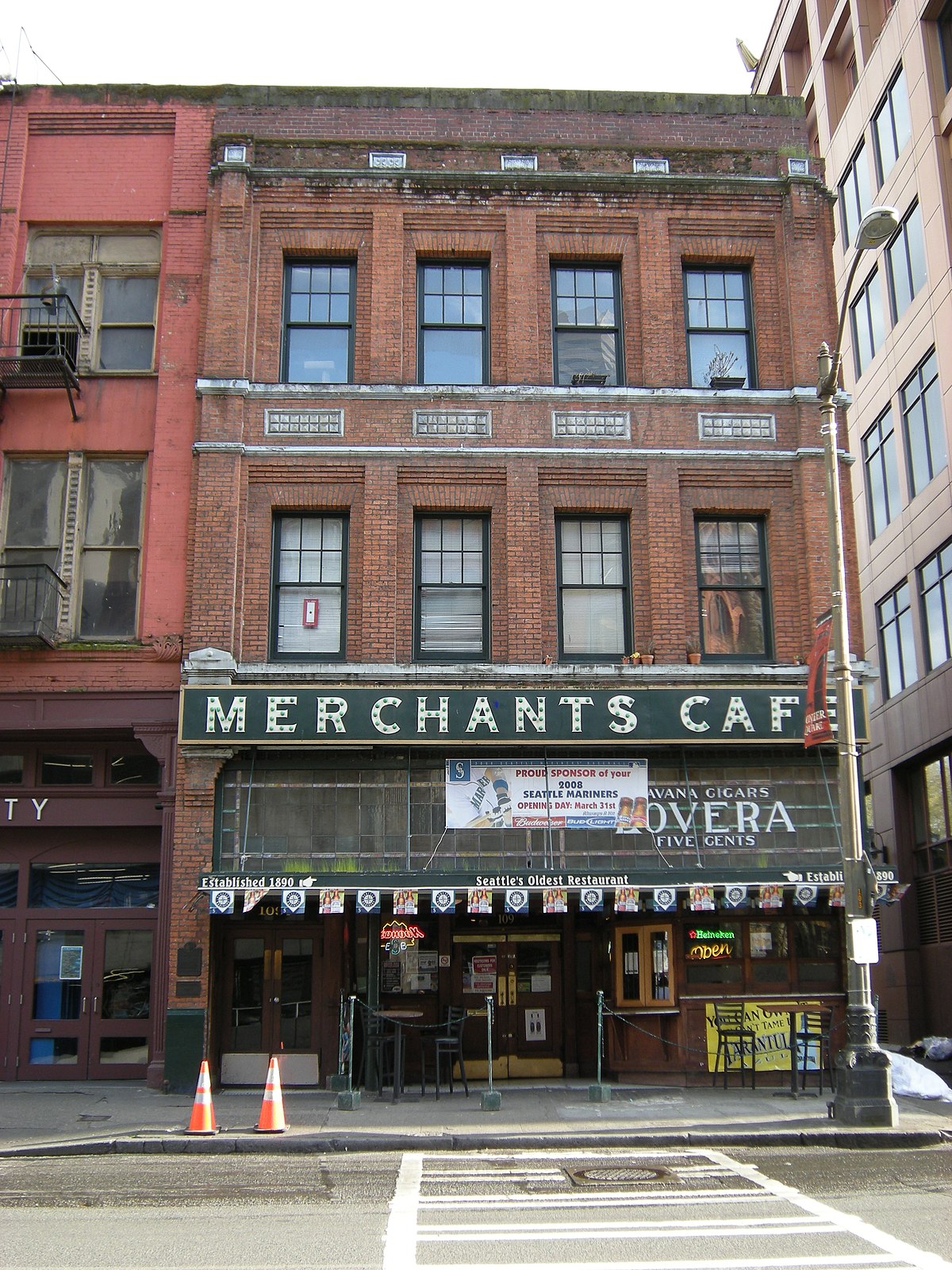
The oldest standing restaurant in Seattle, established in 1890 in Pioneer Square after the Great Fire of 1889, with a 30-foot bar shipped around Cape Horn in the 1860s.
The Ghost Story
The site at 109 Yesler Way has been witness to Seattle's entire history. Before the saloon existed, an 1864 two-story clapboard structure stood here where E.M. Sammis, Seattle's first resident professional photographer, operated a second-floor studio and captured the only known photographs of Doc Maynard and Chief Seattle. That building was destroyed in the Great Seattle Fire of June 6, 1889, which leveled most of downtown. John Hall Sanderson commissioned the current brick-and-terracotta structure in 1890, designed by architect W.E. Boone, a direct descendant of Daniel Boone, at a cost of $15,000. The ground floor opened as a liquor store and cafe, with two floors of hotel rooms above.
In 1892, Charles Osner purchased the building and renamed it the Merchant's Exchange Saloon. Recognizing the demand among Seattle's lonely lumberjacks and Klondike-bound miners, Osner imported women he called "seamstresses" and housed them on the upper floors, with their framed portraits displayed along the back wall of the bar as a selection system for clients. When Franz Xavier Schreiner, a German-born former U.S. Cavalry baker who had served under Lieutenant John Pershing, purchased the saloon in 1898 for $3,000, he expanded operations further. His basement "Sunday Bank" exchanged miners' gold dust for cash, processing as much as $100,000 in a single weekend. Within two years he paid off the mortgage and bought the entire Sanderson Building for $46,000. When Washington state prohibited liquor in 1916, Schreiner quietly moved bootleg alcohol and illegal gambling into the basement while changing the sign to read "Merchants Cafe - Cigars and Soft Drinks." He sold the business to his son Carl and nephew Johann in 1922 for ten dollars each. The Schreiner family would own the cafe for 74 years.
The building's darkest chapter came in 1938, when a fire swept through the structure. The brick walls held, but several people perished inside, including two children, a boy and a girl, who died of smoke inhalation. According to staff, the children likely lived on the upper floors where their mothers worked in the brothel. Their spirits are now the most frequently reported presence in the building. Employees working alone in the basement describe small shadowy figures darting between doorways, the sound of children laughing when none are present, and an unsettling habit of tugging on workers' shirts from behind. An elderly man once walked into the bar carrying an antique doll. He handed it to the bartender and said it was "for the little girl downstairs, the ghost." When asked if he would deliver it himself, he replied, "No, she will be coming up to get it," then left. The doll now sits atop the basement safe.
The most active spirit is Otto, identified by a medium on the Travel Channel's The Dead Files as an early 1900s manager who never stopped working. Owner Darcy Hanson has documented multiple encounters. Once, when a bartender asked Otto to turn off a television that was bothering her, it switched off instantly. On another occasion, Otto tugged twice on Darcy's shirt behind the bar. She dismissed it until a loosely hanging picture crashed to the floor moments after she stepped away from where she had been standing. In November, wine bottles were thrown from a rack above the basement safe overnight. Staff now leave a glass of whiskey on the safe each evening as an offering, and the disturbances ceased.
The upper floors harbor the restless presence of the women who once worked there. Portraits of the former sex workers still hang on the walls, and visitors report seeing the eyes of one painting, an "Oriental dancing girl" by artist Nathaldi Siehel, follow them around the room. When the owner photographed the painting, the image appeared to show furniture, a mirror, and a lamp reflected in the background that were not physically present. In the basement restrooms, doors slam shut on their own, faucets turn on and off, and a woman's voice has been heard whispering into men's ears. A bartender investigating strange noises in the underground bar encountered a man in a charred suit with a severely burnt face who vanished after being spotted, believed to be another victim of the 1938 fire.
AGHOST, the Advanced Ghost Hunters of Seattle-Tacoma founded by Ross Allison in 2001, has investigated the premises and collected evidence used on their associated Spooked in Seattle ghost tours, which have featured Merchant's Cafe as a key stop since 2004. The cafe also appeared on The Dead Files, which confirmed multiple entities. The building temporarily closed on New Year's Eve 2024 for electrical and plumbing renovations under owner Darcy Hanson and reopened in March 2025, with the original carved mahogany bar shipped around Cape Horn, the pressed-tin ceiling, and all its resident ghosts intact.
Researched from 11 verified sources including historical records, local archives, and paranormal research organizations. Learn about our research process.