About This Location
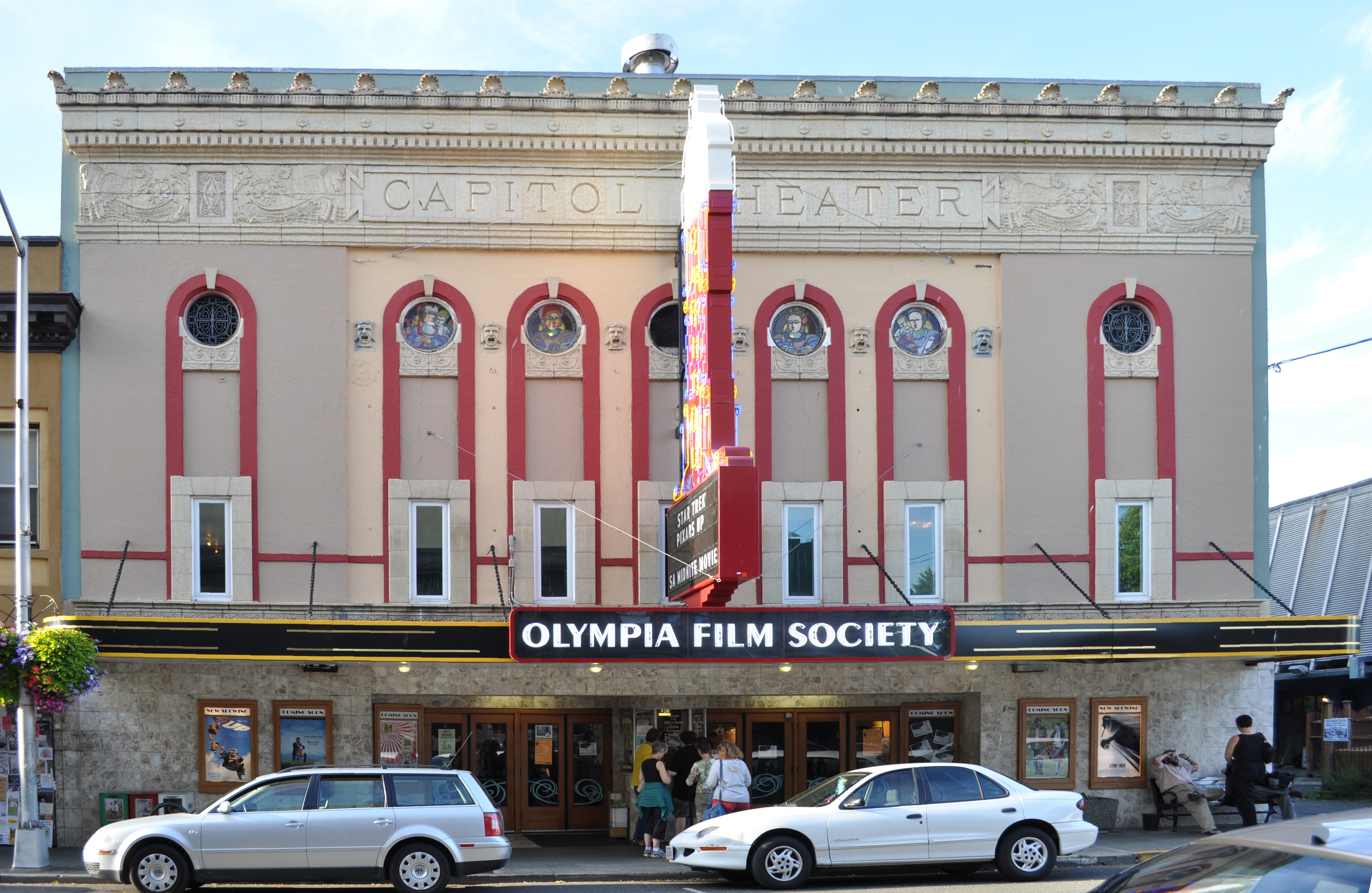
A 1924 theater designed by architect Joseph Wohleb, now home to the Olympia Film Society.
The Ghost Story
On October 7, 1924, over one thousand people filled a brand-new picture palace at 206 Fifth Avenue in downtown Olympia for an evening of organ music, song, dance, and silent films. The Capitol Theater was the crowning achievement of E.A. Zabel and William Wilson, local entertainment moguls who had operated Olympia theaters since 1909. They commissioned Joseph Wohleb, the self-taught architect who would design more than 150 buildings across Washington state during his nearly fifty-year career, to create what he called a "monument to amusement lovers." Wohleb delivered a 762-seat Mission Revival and Beaux Arts jewel: glazed terra cotta adorned the facade, marble lined the floors, circular leaded art glass insets by Northwest artist Raymond Nyson depicted the Greek Muses in backlit panels, and terracotta masks by Polish illustrator W.T. Benda flanked the stained glass windows. Two Smith theater pipe organs were installed in 1926 to accompany the silent films. For the next half-century, the Zabel family ran the Capitol as Olympia's premier venue, hosting film premieres and live performers including Judy Garland.
The theater's darkest day came on the morning of April 24, 1937, when a fire alarm sounded at 9:28 AM. A single reel of highly flammable nitrate 35mm film, delivered the previous evening and temporarily stored in the janitor's closet on the mezzanine, had spontaneously combusted. The flames spread quickly, destroying the balcony, mezzanine, and projection booth and severely damaging the roof and ceiling. Mercifully, the fire struck during morning hours when the theater was empty, and no one was injured. The Capitol closed for four months of repairs, reopening on August 25, 1937, with a brand-new Western Electric Mirrophonic sound system. Many of the original interior features, however, were lost forever. Some believe the 1937 fire marked the beginning of the Capitol's haunted reputation, as though the violent destruction awakened something within the building's walls. The theater survived further trauma when the 6.8-magnitude Nisqually earthquake struck on February 28, 2001, cracking and partially collapsing the ornate plaster ceiling.
The most frequently reported spirit is attributed to Frank Miller, a projectionist who worked at the Capitol during the 1950s. Miller was known for his intense dedication to the job, and according to local accounts, he loved the theater so much that he never truly left. Staff members closing up late at night have reported seeing a shadowy figure in the projection booth, silhouetted against the small window as though threading film through the old projector. Lights flicker on and off without explanation, and on several occasions the projector itself has been observed operating on its own, casting light onto the empty screen as if Miller were running one last show for an audience only he can see. The activity is said to be most intense at night when the theater is being cleaned, as though the ghost mistakes the after-hours routine for the quiet moments before a screening. Those who have encountered him describe him as mischievous but benign, a prankster rather than a menace.
A second presence, known as the Lady in White, has been spotted in the aisles and on the stage. Witnesses describe a woman in old-fashioned clothing, her face partially obscured by a veil, who sometimes appears to be quietly watching a performance from the empty seats before vanishing. One account describes a shadowy figure surrounded by a faint glowing aura walking slowly down an aisle. No official records confirm who she might be, but according to local legend she was a patron who died in the theater under mysterious circumstances. Beyond the two named spirits, staff and performers have reported hearing unexplained footsteps echoing through empty corridors, encountering sudden cold spots in the auditorium, and noticing props that seem to shift position on their own backstage.
In 1980, a group of film enthusiasts formed the Olympia Film Society to preserve the aging theater. The volunteer-run organization became the Capitol's sole tenant in 1986 and purchased the building outright in 2010, launching an ongoing restoration that has included a replica 1924 awning, handcrafted period-correct windows, and a painstaking preservation of the Raymond Nyson stained glass panels that had been hidden behind a 1940s marquee for over seventy years. The Capitol Theater is listed as a Historic Contributing building in Olympia's Downtown National Historic District. It continues to screen independent, international, and classic films, and hosts the annual Olympia Film Festival, a ten-day event drawing five to seven thousand attendees. Whether Frank Miller still runs the projector or the Lady in White still watches from the darkened seats, the Capitol remains one of the Pacific Northwest's most atmospheric venues, a place where a century of stories, living and otherwise, continue to unfold.
Researched from 10 verified sources including historical records, local archives, and paranormal research organizations. Learn about our research process.