
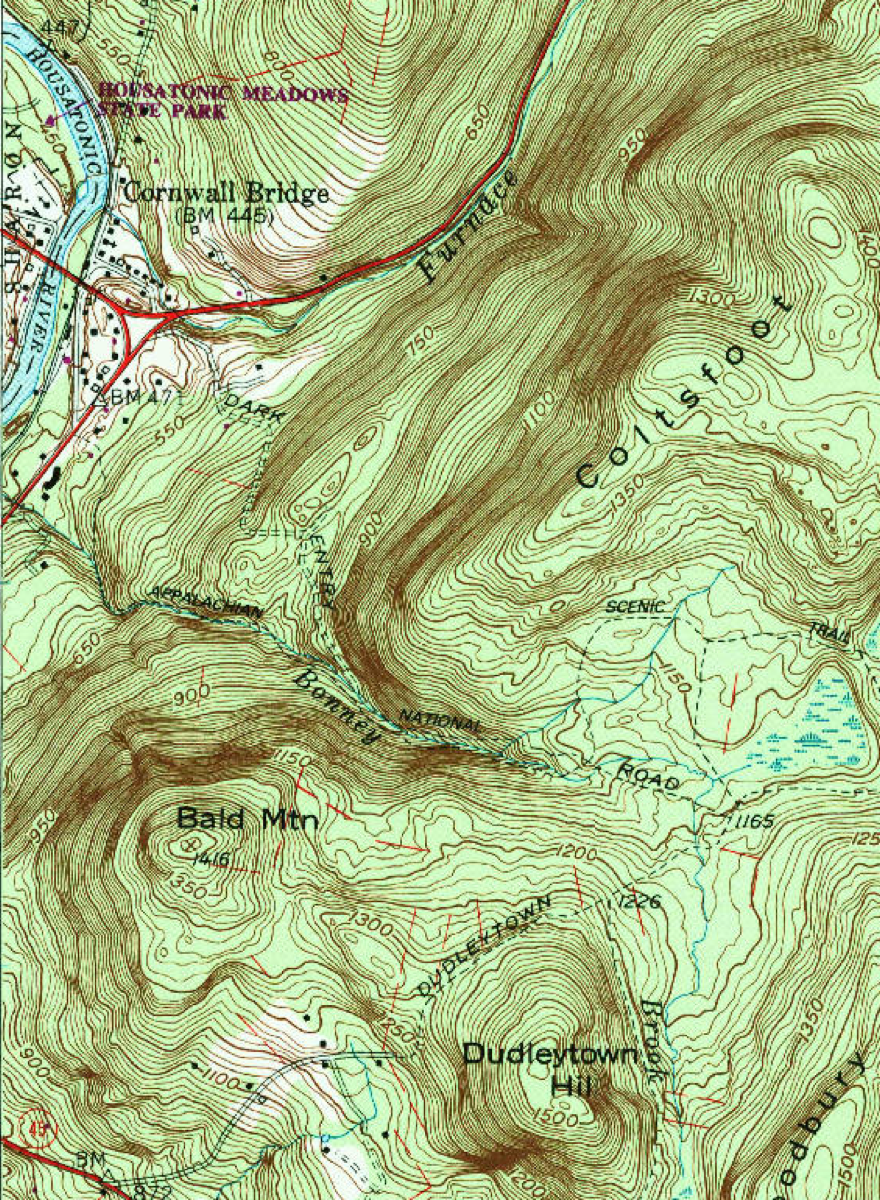
About This Location
An abandoned settlement in the Dark Entry Forest, Dudleytown was settled in the 1740s by the Dudley family. The village declined due to poor soil and distance from water, but legend claims a curse followed the family from England.
The Ghost Story
Deep in the forested hills of northwestern Connecticut lies Dudleytown, one of America's most infamous ghost towns—a place so shrouded in dark legend that it has been permanently closed to the public.
The settlement began innocuously in 1747 when Gideon Dudley purchased land from Thomas Griffis in the shadow of three mountains. His brothers Barzillai and Abiel soon followed, establishing homesteads in the densely wooded valley that would bear their name. The community never flourished—by 1854, only 26 families scratched out a living from the rocky, nutrient-depleted soil. The surrounding peaks created what settlers called "Dark Entry Forest," where the canopy was so thick that darkness fell at midday.
According to legend, the Dudleys carried a centuries-old curse from England. In 1510, Edmund Dudley was beheaded for treason against King Henry VIII. His son John, Duke of Northumberland, later schemed to place Lady Jane Grey on the throne and was executed along with his son Guilford. The curse supposedly followed the family across the Atlantic, manifesting in Dudleytown through madness, tragedy, and death.
The alleged victims accumulated: Gershon Hollister fell to his death from barn rafters in 1792, after which property owner William Tanner went insane, raving about "strange creatures" from the forest. In 1804, lightning struck Sarah Faye on her doorstep, and her husband General Herman Swift reportedly lost his mind with grief. Abiel Dudley himself allegedly descended into madness. The Carter family suffered a brutal Native American attack in 1763 that killed Nathaniel's wife and infant, with three children abducted to Canada.
The final resident, John Patrick Brophy, endured perhaps the most tragic fate. After his wife died of tuberculosis, his two children vanished into the woods and were never found. Brophy set fire to his own home and walked into the forest, never to be seen again. Locals occasionally spotted a disheveled figure wandering the trees, "with torn clothes, muttering things about demons."
The legend gained new life in 1918 when Dr. William Clarke, a prominent New York cancer surgeon who had purchased 1,000 acres including Dudleytown in 1900, was called away on business. He returned 36 hours later to find his wife Harriet in complete hysteria, raving about demonic creatures emerging from Dark Entry Forest. She was institutionalized and later took her own life.
In the 1970s, Ed and Lorraine Warren, the self-proclaimed demonologists famous for investigating the Amityville haunting, descended on Dudleytown. They filmed a televised Halloween special and declared the area "demonically possessed," with Ed Warren stating it was "controlled by something terrifying." Actor Dan Aykroyd, in a 1993 Playboy interview, called it "the most haunted place on earth."
Visitors who dared enter reported an overwhelming sense of dread, disembodied voices whispering through the trees, and shadowy figures darting between the cellar holes—all that remains of the original structures. Some claimed to encounter dark, inhuman creatures lurking in the dense undergrowth, leaving with unexplained scratches and bruises. Most unsettling is the deathly silence: no birdsong, no rustling wildlife, as if nature itself has abandoned the place.
However, historians have debunked much of the mythology. Rev. Gary P. Dudley, a genealogist (unrelated to the settlers), researched the claims for his 2001 book and found no connection between Dudleytown's founders and the English nobility. The Cornwall Historical Society confirmed that General Swift never lived in Dudleytown, Mary Cheney Greeley never set foot there, and Harriet Clarke committed suicide in New York City, not the forest. The "curse" was likely economic: the Bessemer steelmaking process eliminated demand for charcoal timber, and families simply left for better opportunities out West.
Today, the Dark Entry Forest Association—founded by Dr. Clarke in 1924 after remarrying—owns the land and vigorously prohibits all visitors. The 1999 film "The Blair Witch Project" sparked renewed trespassing, occult rituals, and vandalism, forcing permanent closure. State police patrol the area, issuing $110 fines and arresting trespassers. As former Cornwall Historical Society president Harriet Clark stated: "There are no ghosts, no spirits and no curse." The forest keeps its secrets behind No Trespassing signs.
Researched from 15 verified sources including historical records, local archives, and paranormal research organizations. Learn about our research process.