About This Location
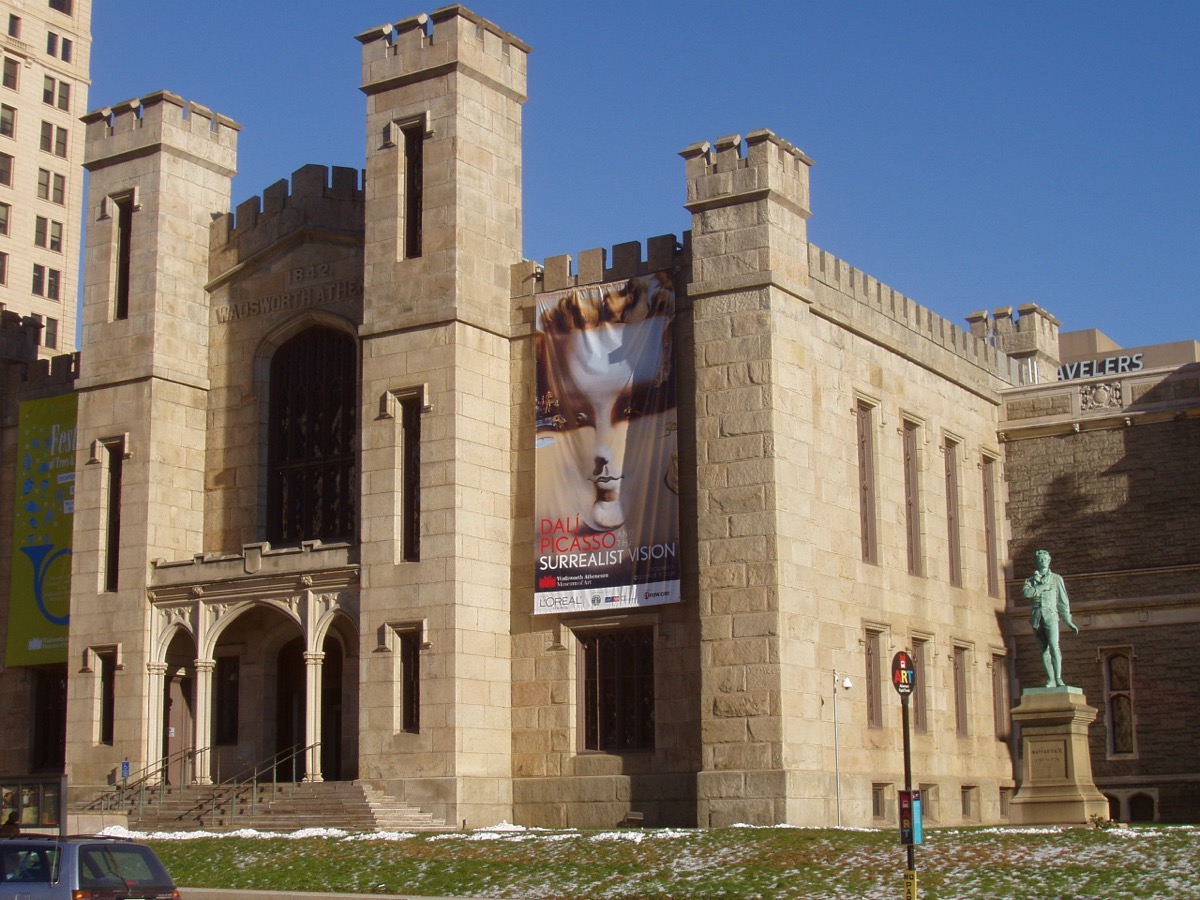
The oldest continuously operating public art museum in the United States, founded in 1842. The Gothic Revival building houses a collection of nearly 50,000 works spanning 5,000 years.
The Ghost Story
The Wadsworth Atheneum is America's oldest continuously operating public art museum, and within its Gothic Revival walls lingers the spirit of a devoted scholar who never truly left his beloved books. The museum opened on July 31, 1844, the creation of Daniel Wadsworth, a wealthy Hartford patron of the arts who married Faith Trumbull, niece of the great Revolutionary War painter John Trumbull. Designed by renowned architects Ithiel Town and Alexander Jackson Davis, the original building is a striking castle of Connecticut granite featuring crenelated towers, pointed arches, and a medieval grandeur that makes it the perfect home for unexplained phenomena.
The ghost of the Wadsworth Atheneum has a name: Reverend Thomas Robbins. Born in Norfolk, Connecticut in 1777, Robbins was a Congregational minister, bibliophile, and antiquarian who became the first librarian of the Connecticut Historical Society when it moved into the Atheneum in 1844. A lifelong bachelor devoted to scholarship, he kept a diary from 1796 until 1854 and amassed a personal collection of over 4,000 volumes on history and theology, including rare treasures like the 385-volume Journal des scavans, the earliest scholarly periodical. His portrait by Reuben Moulthrop shows a white-haired old man in a straight-backed chair, surrounded by books and papers—the very image of a soul wedded to learning.
Robbins served as librarian until 1854 and died in Colebrook, Connecticut in 1856 at age 79, bequeathing his entire book collection and ,000 to the Connecticut Historical Society. But employees believe he never truly departed the building where he spent his final working years.
By 1891, staff members were convinced the Atheneum was haunted by Robbins himself. The story went public on July 10, 1911, when The Bridgeport Times and Evening Farmer published interviews with past and present employees who gathered to share their unexplained experiences. Among those interviewed were Miss Caroline Hewins, librarian of the Hartford Library who had worked in the building since 1875; Frank Gay, curator of the Atheneum who began his career there in 1876; Alfred Bates, librarian of the Connecticut Historical Society; and Alfred Clifford, superintendent of the building.
The phenomena they described centered on mysterious footsteps. Staff would hear the distinct sound of someone walking down the stairs toward the basement, but investigation revealed no one there—only the fading echo of footfalls. Doors slammed without explanation. In the reading room, patrons complained of strange sounds and rustling newspaper noises when they were entirely alone, with no breeze or disturbance to account for the sound.
Caroline Hewins confessed to being nervous when she had to work during late afternoon or closing time, especially during winter months when darkness came early and the Gothic building took on an even more ominous atmosphere. None of the witnesses wanted to explicitly declare belief in ghosts on the record, yet as one said with a shrug: "I heard what I heard."
The employees who experienced these phenomena had no doubt about the ghost's identity. They identified the mysterious footsteps as belonging to Thomas Robbins—the dedicated librarian still making his rounds, still tending to his beloved collection.
In 1892, the Atheneum underwent major renovations. As a worker prepared to remove Robbins' portrait from the wall, he was warned to be careful: "That's the building's ghost." The worker smiled dismissively, lifted the painting, and promptly dropped it. The canvas tumbled from its frame and curled up on the floor. Though the painting was saved and reframed, employees claim that was the end of the ghost—as if disturbing his portrait had finally released the scholarly spirit from his earthly attachment.
Yet the Atheneum's supernatural reputation endures. The museum—which holds nearly 50,000 works spanning 5,000 years, including the first Caravaggio and first Salvador Dali purchased by an American museum—remains a stop on Hartford ghost tours. Visitors marvel at the castle-like exterior while guides share tales of the spectral librarian who still wanders the marble halls. Today the complex comprises five connected buildings from 1844 to 1969, but it is the original Gothic Revival structure where the ghost of Thomas Robbins is said to linger, forever checking on the books and papers that were his life's devotion.
Researched from 9 verified sources including historical records, local archives, and paranormal research organizations. Learn about our research process.