
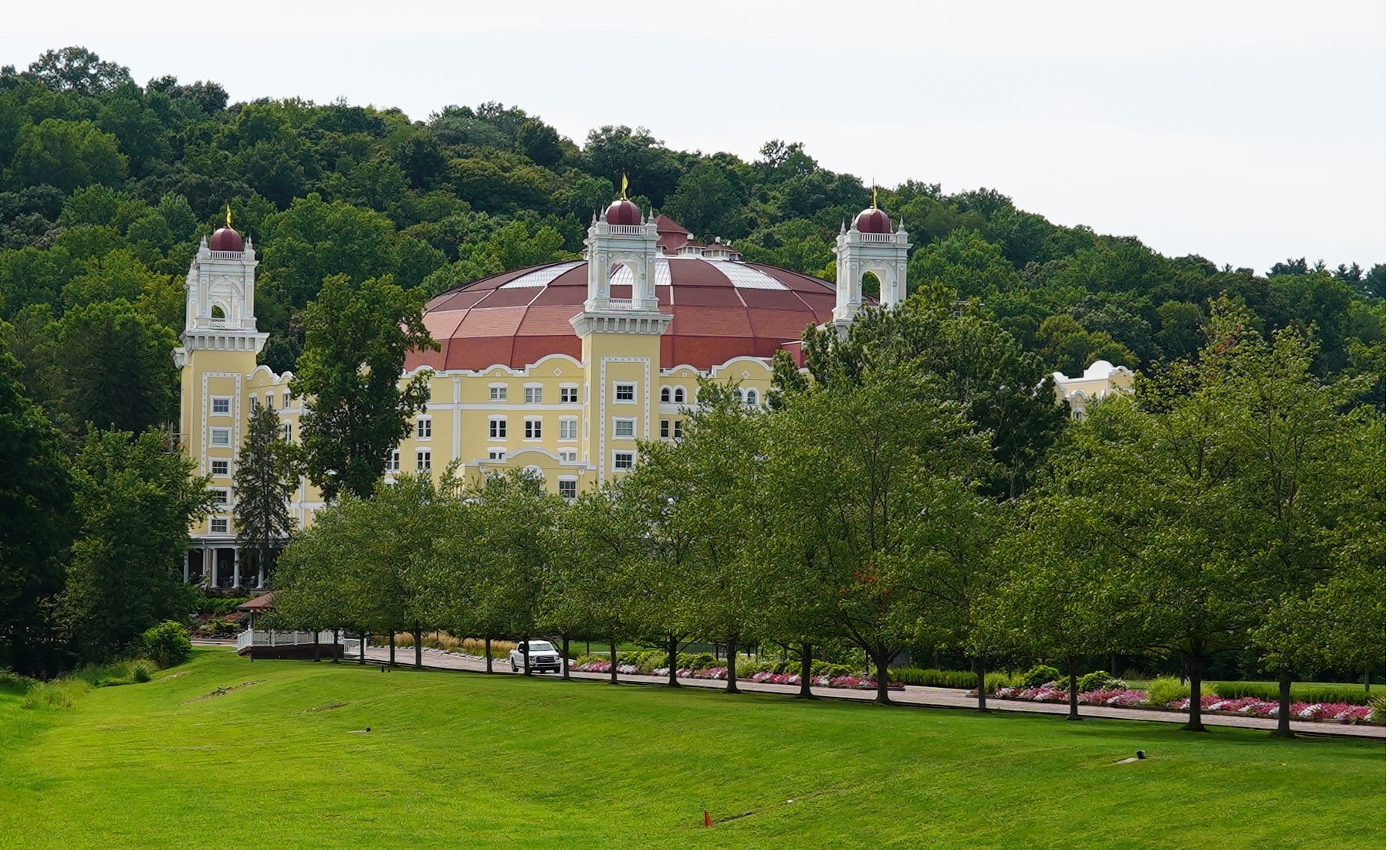
About This Location
A National Historic Landmark featuring the world's largest free-span dome when built in 1902. The atrium dome spans 200 feet. The hotel served as a Jesuit seminary and military hospital before being restored and reopened in 2007.
The Ghost Story
The West Baden Springs Hotel in Orange County, Indiana, was once called the Eighth Wonder of the World. Built in 1902 by entrepreneur Lee Sinclair, the hotel features a massive 200-foot free-spanning dome that was the largest in the world at its construction -- a record it held until the Houston Astrodome opened in 1965. Architect Harrison Albright designed the stunning atrium, which rises six stories above a sunlit central court. The hotel was built to capitalize on the area's mineral springs, and in competition with the neighboring French Lick Springs Hotel, West Baden marketed its waters under the brand name "Sprudel Water," complete with a mascot elf named Sprudel. The resort boasted its own opera house, orchestra, theater, double-deck pony and bicycle track, and casino.
Among the hotel's most infamous guests was Al Capone, who visited year after year during the 1920s with his bodyguards. While the French Lick Springs Hotel down the road reportedly barred the crime boss, West Baden was open to Capone and his associates. The hotel hosted illegal gambling operations that attracted the wealthy and the criminal alike during the Prohibition era, adding a layer of vice and violence to the resort's glittering facade.
The hotel's fortunes declined after the Great Depression. In 1934, owner Ed Ballard -- though not himself a Catholic -- donated the massive property to the Society of Jesus for use as a seminary. The Jesuits sealed all the mineral springs with cement and converted the resort into a training facility for priests. Thirty-nine Jesuit priests who died during their tenure at the building were buried in a cemetery on the grounds, their graves a testament to the decades the order spent within the dome's shadow.
The most mysterious discovery came during the hotel's renovation in the 1990s, when workers found the Angel Room -- a tiny cylindrical chamber at the top of the atrium just below the center of the dome. The room's walls are lined with a series of mysterious oil paintings of angels, created during the Jesuit seminary era. The paintings are believed to be the work of a seminarian who died at the facility, his artistic devotion preserved in a hidden space that went undiscovered for decades. The Angel Room has become one of the hotel's most discussed features, a sacred space concealed at the crown of a building built for earthly pleasures.
Former guests and employees have reported encountering unexplained phenomena throughout the hotel. Visitors describe hearing footsteps in empty hallways, particularly in the upper floors near the rooms once occupied by seminary students. Shadowy figures have been seen moving through corridors, and an unsettling presence has been felt in areas near the old Jesuit cemetery. The combination of the hotel's layered history -- Gilded Age excess, Prohibition-era gambling, decades of religious devotion, and the accumulated weight of the thirty-nine priests buried on the grounds -- creates a spiritual atmosphere that many visitors describe as palpable.
Author Michael Koryta visited the hotel's ruins at age eight and was so haunted by the experience that he wrote the supernatural thriller So Cold the River eighteen years later. The novel, which was adapted into a 2022 film shot on location at the hotel, centers on a malevolent force connected to the hotel's mineral springs, drawing on the real history of the area's Pluto Water -- a patent medicine manufactured in nearby French Lick that "claimed to cure any affliction known to man."
The West Baden Springs Hotel was restored and reopened in 2007 as part of the French Lick Resort, and it is now a National Historic Landmark. The dome still inspires awe, the Angel Room still holds its mysteries, and the spirits of the hotel's many lives -- resort guests, gangsters, seminarians, and priests -- are said to linger in the grand space beneath that extraordinary ceiling.
Researched from 7 verified sources including historical records, local archives, and paranormal research organizations. Learn about our research process.