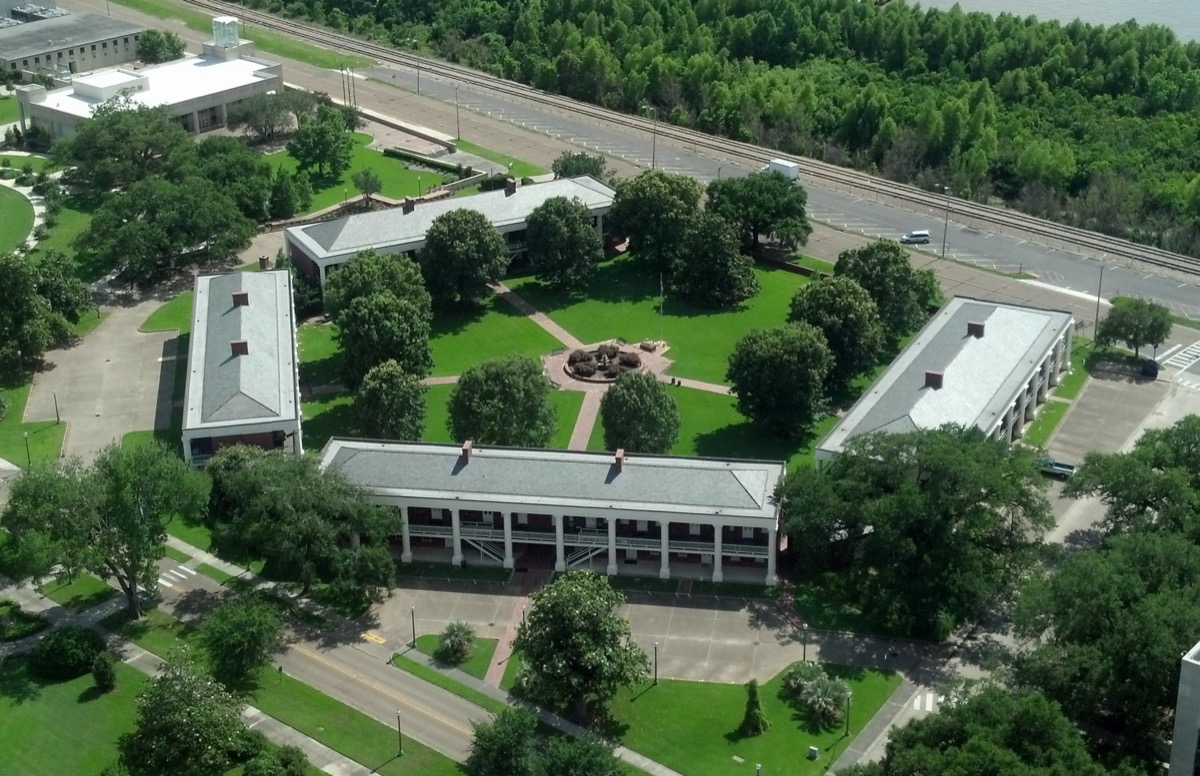
About This Location
Constructed from 1819 to 1825, these military barracks have served as U.S. Army housing, part of LSU's campus, and currently as residences for Louisiana legislators. The distinctive pentagon-shaped layout gives the complex its name.
The Ghost Story
The Pentagon Barracks were constructed between 1819 and 1825 on the banks of the Mississippi River in Baton Rouge, designed by Captain James Gadsden of the U.S. Army as a military garrison. The two-story brick buildings were arranged in the shape of four sides of a regular pentagon, with a fifth building housing a commissary and warehouse completing the formation. The barracks served as an active military post for nearly six decades and hosted some of the most prominent figures in American military history, including future generals Robert E. Lee, Wade Hampton, and Thomas Stonewall Jackson, all of whom were quartered there at various times during their service.
The barracks' darkest period came during the Civil War. In January 1861, the State of Louisiana seized the facility and the adjoining arsenal from Union troops in a bloodless takeover, turning operations over to the Confederate States of America. The Confederates held the barracks until 1862, when the Union recaptured Baton Rouge in a bloody engagement. The Battle of Baton Rouge on August 5, 1862, left the town badly damaged and claimed numerous soldiers from both sides, including Union Brigadier General Thomas Williams, who was killed in action. The Union army subsequently renamed the facility Fort Williams in his honor. The barracks continued as a military post through Reconstruction, finally closing in 1877. The buildings later served as part of LSU's campus before being converted to their current use as private apartments for state legislators and offices for the lieutenant governor.
The haunting of the Pentagon Barracks is dominated by a figure known as the Shadow Man, described as a black mass in the shape of a man without any visible features. Unlike many of the gentler ghosts found elsewhere in Baton Rouge, the Shadow Man is reported as hostile. Maintenance workers performing repairs in the apartments have reported seeing the entity moving through the units, and some have come face-to-face with the spirit. Each worker who has encountered the Shadow Man at close range has noted what they perceive as its intention to cause harm. The encounters have been unsettling enough that some maintenance staff are reluctant to work alone in certain areas of the building.
The haunting has extended to the barracks' current residents as well. Legends about the Shadow Man and other unexplained occurrences have circulated for years among Louisiana legislators, and some have chosen to move out of their assigned apartments or refused to move in altogether, citing the paranormal disturbances. Beyond the Shadow Man, visitors and staff have reported disembodied voices, phantom footsteps echoing through the courtyards and hallways, flickering lights with no electrical explanation, and the persistent feeling of being watched. Given the barracks' long history as a military post and the violence of the Civil War battles fought around them, the Pentagon Barracks contain more than enough tragedy to account for the restless spirits that seem unwilling to abandon their post.
Researched from 5 verified sources including historical records, local archives, and paranormal research organizations. Learn about our research process.