
About This Location
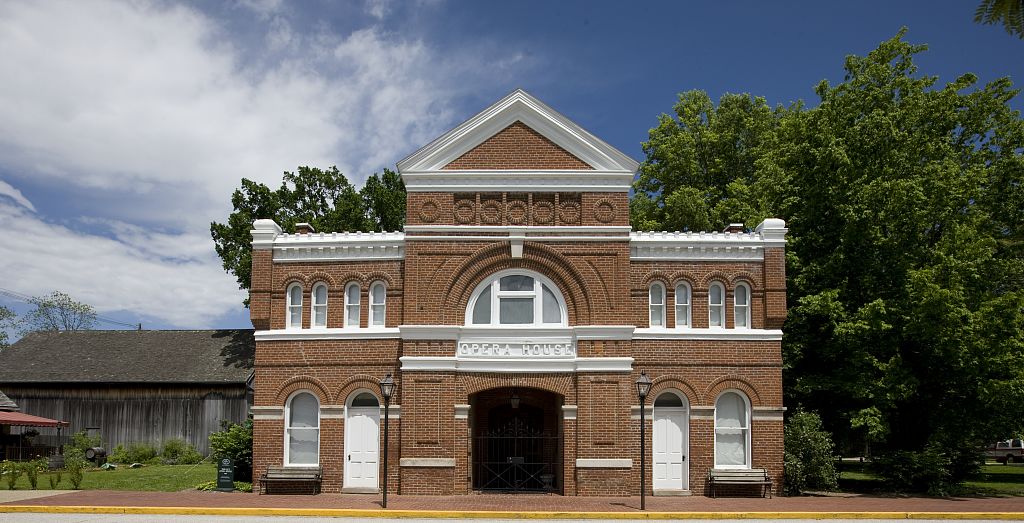
An opera house in the historic utopian community of New Harmony, founded as a Harmonist settlement in 1814 and later the site of Robert Owen's utopian experiment in 1825. The town is home to many reportedly haunted buildings.
The Ghost Story
Thralls Opera House at 612 Church Street in New Harmony, Indiana, stands at the heart of one of America's most historically significant utopian communities. The building was originally constructed around 1824 by the Harmonists, a German Lutheran sect who established New Harmony with the ideals of order, simplicity, and peace, believing these principles could create world peace. The structure initially served as communal housing for Harmonist members without families. When the utopian experiment failed, the building passed through various uses -- school, theater, storage facility -- before Eugene Thrall converted it into an opera house in the late nineteenth century. The Golden Family, a nationally touring performance troupe, made Thralls Opera House their home base, performing there between engagements across the country.
The ghost of Eugene Thrall himself is the opera house's most enduring spirit. Described as the venue's "eternal guardian," Thrall's presence has been reported consistently over many decades. He appears to watch over the theater he created, a proprietor still checking on his establishment from beyond the grave. His apparition has been associated with the stage area and the spaces behind it where props and performance materials are stored, including the piano that once belonged to Francis Golden of the performing family.
A second identified spirit is Gus, a maintenance man who haunts the ladies' dressing room. His presence is described as a lingering, territorial energy -- Gus apparently has not relinquished his custodial duties despite no longer being among the living. Souls from the past are said to linger in the darkest shadows of the building, and paranormal investigators have documented a range of phenomena including full-bodied apparitions, footsteps on the stairs, and disembodied voices on the stage.
New Harmony's broader history of failed utopian idealism -- first the Harmonists, then the Robert Owen community that succeeded them -- has left what many believe to be a permanent spiritual residue on the town. The intensity of belief and the depth of disappointment when those beliefs were shattered may have created conditions conducive to hauntings throughout the community. The David Lenz House, another Harmonist structure, generates "knock-back" responses when visitors knock on its doors, accompanied by shadowy figures. The Roofless Church contains an "angel's footprint" associated with paranormal forces. The Ribbeyres Center, site of a devastating 1925 tornado, produces unexplained laughter and autonomous door movements.
Paranormal author Joni Mayhan has written extensively about New Harmony's ghosts in her book Haunted New Harmony, and the town hosts regular ghost walks that depart from the opera house entrance. The Church Street Mysteries Ghost Walk takes visitors through a mile of New Harmony's most haunted locations, with Thralls Opera House serving as both the starting point and one of the tour's centerpiece destinations. US Ghost Adventures also operates a New Harmony ghost tour that features the opera house prominently.
Today, Thralls Opera House continues to serve as a community gathering center, hosting performances and events much as it did in Eugene Thrall's day. The building's layers of history -- from Harmonist communal living to theatrical performances to paranormal investigations -- make it a uniquely layered haunted location, where the spirits of utopian dreamers, Victorian entertainers, and dedicated workers share the same shadowed stage.
Researched from 7 verified sources including historical records, local archives, and paranormal research organizations. Learn about our research process.