
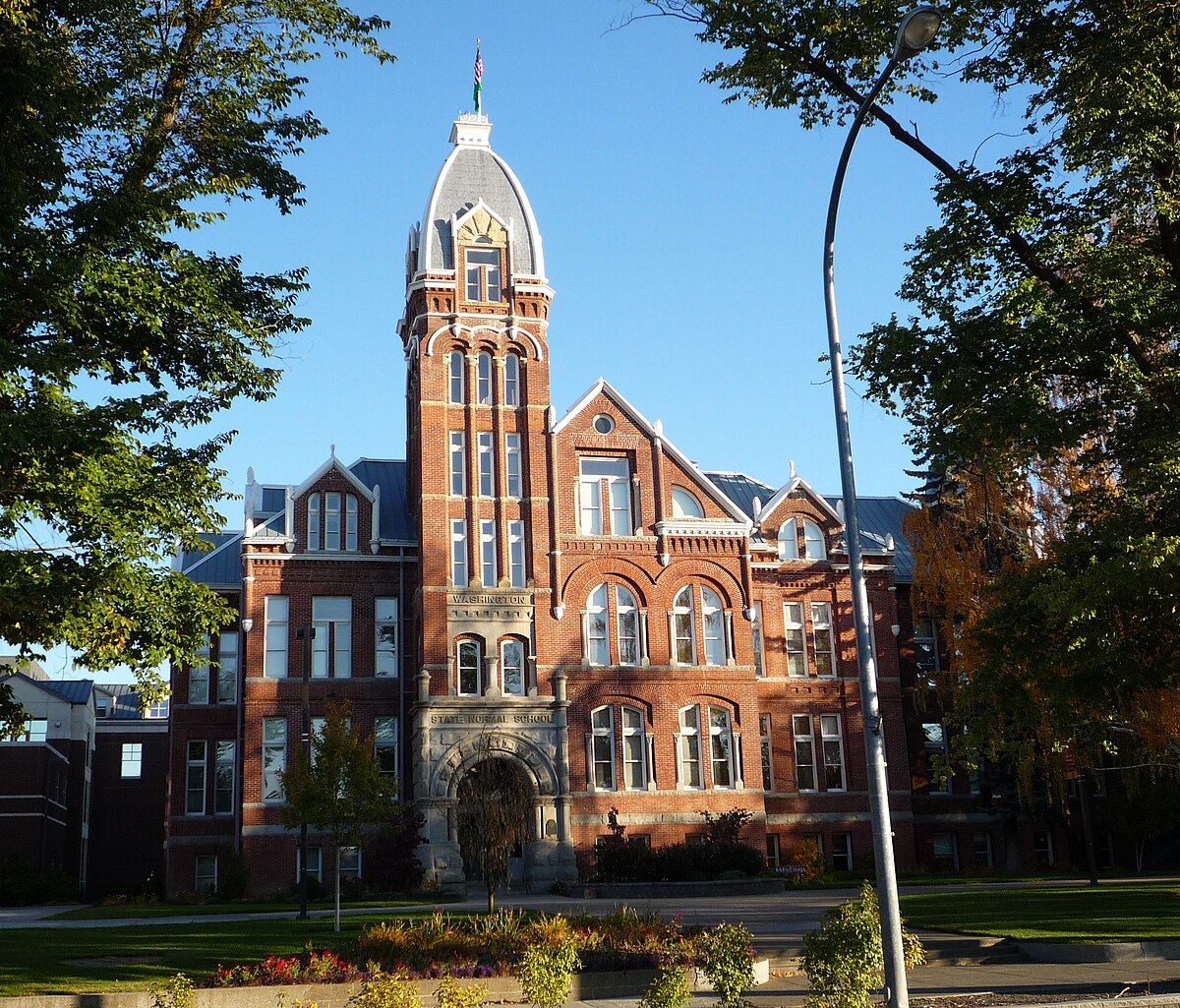
About This Location
A public university founded in 1891, home to Kamola Hall, a 1911 women's dormitory with one of Washington's most enduring campus ghost legends.
The Ghost Story
Kamola Hall was completed in October 1911 as the first dormitory on the campus of what was then Washington State Normal School, founded in 1891 with just 51 students. Designed by renowned Spokane architect Kirtland Cutter, who also created the Davenport Hotel and Seattle's Rainier Club, the Swiss chalet-style residence was constructed from locally made bricks and featured original handmade colored tile surrounding its fireplaces. In 1916, the dormitory received its name at the suggestion of early Ellensburg businessman Andrew Jackson Splawn, honoring Kamola, the daughter of Yakama Chief Owhi, who was widely respected throughout the Kittitas Valley region.
The legend of Lola -- the ghost said to haunt Kamola's sealed upper floors -- is one of Washington's most enduring campus ghost stories, despite being almost certainly fictional. According to the version published in CWU's Crimson and Black alumni magazine, Lola was a student in the 1940s whose fiance was drafted into World War II and killed in combat. Overcome with grief, she put on her wedding dress and hanged herself from the attic ceiling. The story has a critical historical problem: during World War II, Kamola Hall housed approximately 400 male U.S. Air Force cadets training at the college and airfield, and did not revert to a women's dormitory until after the war ended. More damning still, in 2003 The Observer interviewed CWU alumnus Evan Sylvanus, who stated that Lola was a character invented in 1982 to promote a haunted house event held in Kamola. Despite thorough searches, the university archives have found no record of any student named Lola dying in the building.
Yet the paranormal activity reported in Kamola persists independently of the legend's veracity. During a summer 2002 photoshoot in Kamola's attic, CWU photographer Richard Villacres staged a model in a 1940s-era wedding dress. Of his three rolls of film, two came out completely black. The surviving roll showed unexplained fogging and dark marks, with one final slide depicting fog surrounding everything except the model's dress, which remained oddly in focus, along with what Villacres described as a ghostly figure visible in the hallway behind her. Polaroid examined the film and found no technical defect. His other equipment functioned normally outside Kamola. Villacres stated simply, "She screwed with my film, and honestly, I have no explanation for it."
The building's upper level was officially closed in the 1960s for fire code violations, though campus rumor insists the real purpose was to contain whatever presence inhabits Kamola's attic fourth floor. The 55,700-square-foot dormitory consists of four wings, two of which have an attic fourth floor that remains off-limits to residents. Deemed structurally unsafe by the 1990s, the building was shut down entirely before undergoing approximately $10 million in renovations, reopening in 2004 with seismic upgrades and modern infrastructure. The ghosts apparently survived the construction. A construction worker's father who participated in the remodel during the late 1980s and early 1990s reported hearing a woman crying when no students had access to the building. The man, described as an old-timer who did not believe in ghosts, said the sound made the hair stand up on his arms.
Modern residents continue to report phenomena. Former resident Jadin Pearson, now a U.S. Army lieutenant, recalled that the doors in Kamola were thick and heavy, yet she would see them open and close on their own. Ambree Hollenberry described walking to the bathroom late at night and feeling something behind her, observing shadows disappearing into walls, especially into the lounge near the stairwell on the second floor. Freshman Alex Snyder reported seeing wispy smoke and hearing small footsteps at night despite there being no children in the building. Other residents have reported computers spontaneously playing music, whiteboard messages appearing that reference Lola, and fireplaces lighting without explanation. An alternate version of the legend names the ghost Lola Wintergrund and claims she leapt from Courson or Muzzall Hall across the street before her spirit migrated to Kamola. The Crimson and Black has published accounts attributing four deaths in Kamola to Lola's paranormal presence, though these claims remain unsubstantiated.
Kamola is not the only haunted building on the CWU campus. Residents of Beck Hall have reported seeing apparitions in the hallways, and Room C-37 in Barton Hall is believed to be haunted by the ghost of a former student whose apparition has been witnessed alongside unexplained noises. When the Centerstate Paranormal Investigations group, founded by Richard and Char Flynn in 2015, specifically requested permission to investigate Kamola Hall with their electromagnetic readers, infrared thermometers, and audio recorders, the university denied the request -- a refusal that, to believers, only deepens the mystery of what the institution might prefer to keep sealed behind those closed attic doors.
Researched from 9 verified sources including historical records, local archives, and paranormal research organizations. Learn about our research process.