About This Location
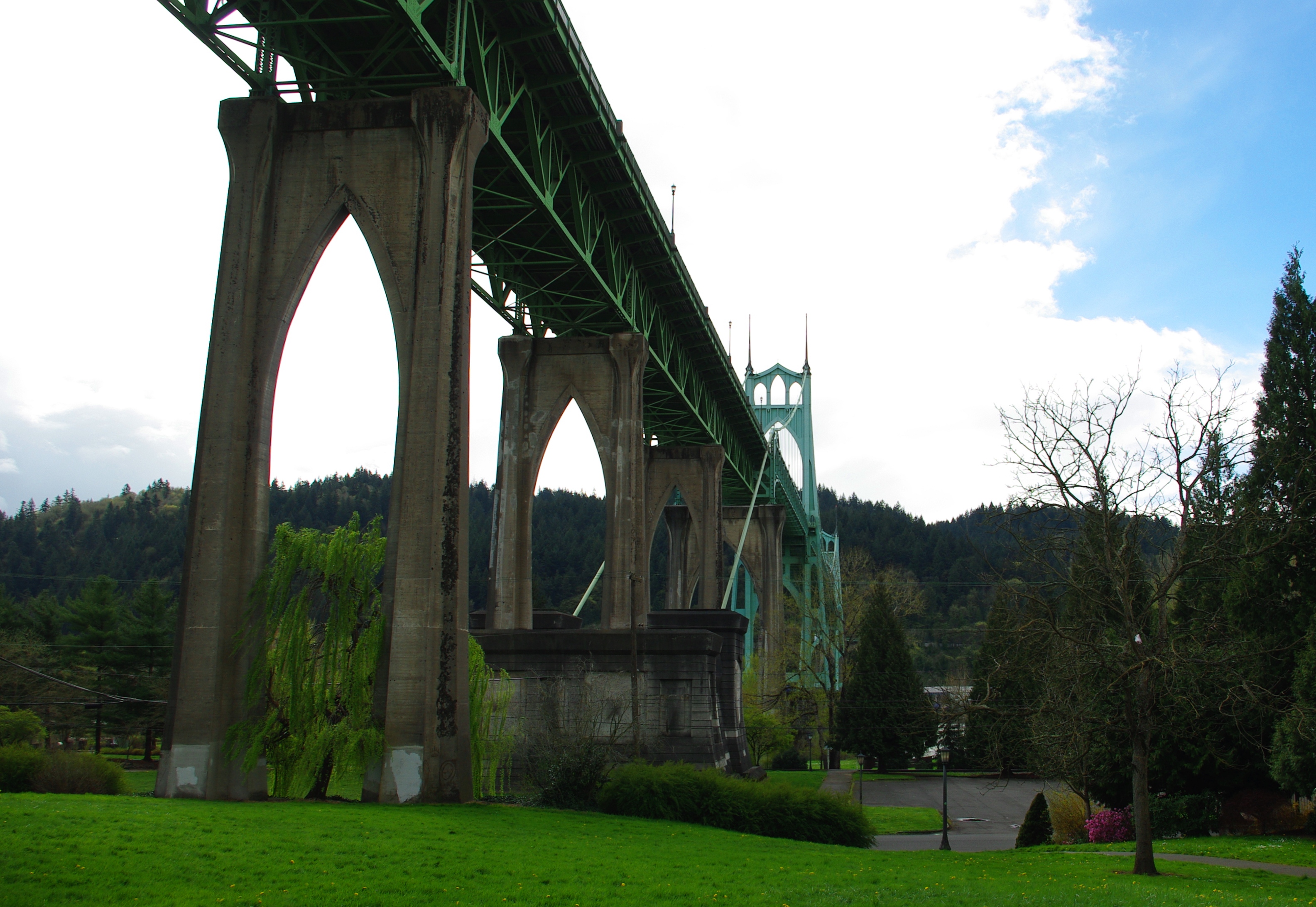
A park beneath the Gothic arches of the St. Johns Bridge in North Portland, named for the cathedral-like columns supporting the 1931 suspension bridge.
The Ghost Story
Cathedral Park sits beneath the soaring Gothic arches of Portland's St. Johns Bridge, a suspension bridge designed by David B. Steinman that opened on June 13, 1931. With its twin 400-foot towers and cathedral-like pointed arches, the bridge was the longest suspension span west of the Mississippi at the time of its construction. The park itself was not established until 1980, when the city converted what had been acres of tangled blackberry bushes, abandoned cars, and garbage dumps into a public green space along the Willamette River. But decades before it became a park, this stretch of riverbank became the site of one of Portland's most tragic crimes.
Shortly after 4:00 a.m. on August 5, 1949, fifteen-year-old Thelma Anne Taylor, a sophomore at Roosevelt High School, was waiting for a bus on North Fessenden Street in the St. Johns neighborhood. She was heading to Hillsboro, about seventeen miles away, to pick beans for the summer. Morris Leland, a twenty-two-year-old ex-convict and drifter, approached her and lured her to a secluded area near the river. That night the two slept in a wooded area near the Willamette. In the early morning hours of August 6, Taylor heard railroad workers switching cars at a nearby train yard and began screaming for help. Leland silenced her by striking her repeatedly with a piece of steel rebar, then stabbing her with a knife. He buried her body in a shallow grave beneath a pile of driftwood and logs.
Six days later, around 2:00 a.m. on August 11, Leland was arrested by Portland police on an unrelated car theft charge. During questioning, he confessed unprompted to kidnapping and murdering Taylor, though he had not been a suspect. His trial began October 4, 1949, and on November 11 he was convicted and sentenced to death. After appeals, Morris Leland was executed in the gas chamber at the Oregon State Penitentiary in Salem on January 9, 1953.
The ghost story that grew around Cathedral Park holds that on warm summer nights, visitors can hear the anguished screams of a young girl echoing beneath the bridge's Gothic arches. Some report hearing a voice crying out "Help! Somebody help me, please!" carried on the wind along the river. The atmospheric conditions of the site lend themselves to the legend: the bridge's concrete pillars amplify and distort sounds, the wind howls through the arches, and the flowing Willamette creates an ever-present murmur. Paranormal researchers have pointed to the Stone Tape theory, which holds that traumatic events can imprint on surrounding stone and water and replay under certain conditions, as a possible explanation for the reported phenomena.
Several paranormal groups have investigated the site. The Northern Woods Paranormal Research and Investigations conducted extensive fieldwork in 2007 and 2008, even obtaining official documents from the City of Portland archives and performing excavation work at the site. Their investigation, featured in a Portland newspaper in October 2008, ultimately concluded that the haunting was legend rather than documented paranormal activity. In August 2020, investigators from Sinister Coffee and Creamery conducted their own visit on the seventy-first anniversary of the murder, attributing the eerie sounds they recorded to traffic, wind, and the bridge's acoustic properties rather than supernatural causes.
Crucially, researcher Erik Meharry, who created a memorial Facebook page for Taylor in 2012, discovered through historical records that the murder actually occurred approximately eight blocks from the bridge, not in what is now Cathedral Park. The popular legend had also inflated Taylor's captivity from one night to seven days. In September 2012, Meharry was contacted by Paulette Jarrett, Taylor's younger sister, who was three years old at the time of the murder. Jarrett shared personal memories of her sister, including Thelma sharing gum and posing in their father's uniform. Author Colin Dickey examined the case in his 2016 book Ghostland: An American History in Haunted Places, noting the ethical tension between the ghost story that has kept Taylor's memory alive and the way it reduces a real person to a cautionary folktale. Meharry himself ultimately urged others to leave this particular ghost story alone out of respect for the family. Today Cathedral Park is a beloved Portland green space hosting the annual Cathedral Park Jazz Festival, though the story of Thelma Taylor continues to draw those seeking an encounter with Portland's most sorrowful ghost.
Researched from 8 verified sources including historical records, local archives, and paranormal research organizations. Learn about our research process.