About This Location
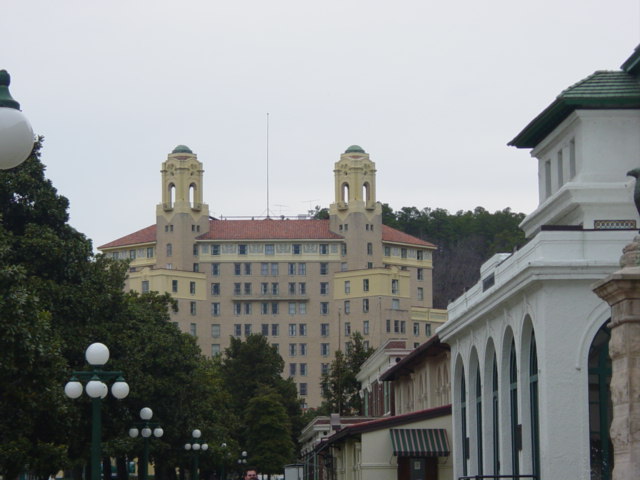
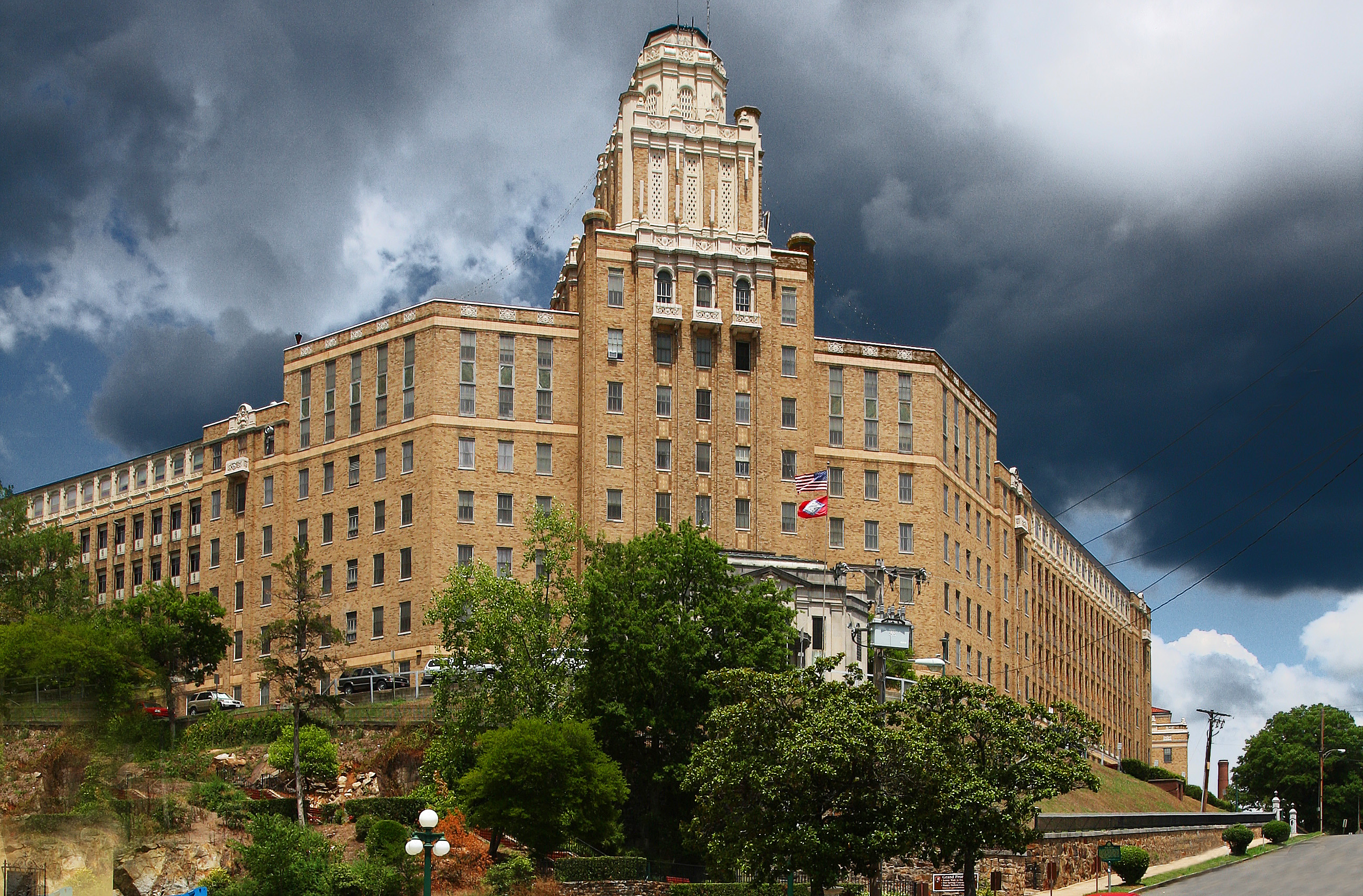
The giant looming abandoned building behind Bathhouse Row was previously the Army-Navy Hospital, built in 1933 to serve veterans. It has sat largely empty for decades.
The Ghost Story
The Army and Navy General Hospital in Hot Springs, Arkansas, was the nation's first combined general hospital for both U.S. Army and Navy patients, and the only military hospital in American history established solely because of its proximity to thermal springs. The idea was conceived at an 1882 dinner party on the second floor of the Palace Bathhouse, where Dr. A.S. Garnett, a former Confederate army surgeon, hosted U.S. Senator John A. Logan, a former Union general. The impressed senator called Hot Springs "an ideal location for an institution of this character" and promised to introduce legislation upon his return to Washington. By the end of June, Congress approved $100,000 for a thirty-bed joint military hospital, and President Chester A. Arthur signed the bill into law. The hospital opened to patients in January 1887, its original building designed in the High Victorian Gothic style with a four-story wraparound veranda that afforded views of Bathhouse Row and the central business district below.
The present building, a towering Spanish Revival structure with a four-story ziggurat tower lined with alternating pilasters and diamond-shaped perforated panels, was completed in 1933 at a cost of $1.5 million — approximately $33 million today. The new building held 500 patient beds across 210,000 square feet, with two large patient wings flanking the central entrance. The hospital became the army's leading medical facility for treating arthritis and polio through hydrotherapy, utilizing modern vapor cabinets, underwater pools, and whirlpool equipment fed by the hot springs. During World War II, the facility reached its peak, admitting nearly 15,000 patients between 1941 and 1945, with over 1,800 arriving in the single month of June 1945 alone. In 1943, the hospital established the first Army Arthritis Center and the first Medical Department Enlisted Technicians School for the Women's Army Corps. By 1945, the hospital had served more than 100,000 veterans across its history.
The military announced closure plans in 1952, and on April 1, 1960, the Secretary of the Army transferred the thirty-building complex to the State of Arkansas for use as the Hot Springs Rehabilitation Center. The facility later served as the Arkansas Career Training Institute before closing permanently in September 2019. The massive complex now stands vacant, its Spanish Revival facade overlooking Bathhouse Row like a castle on a hill.
According to local accounts repeated by Austin Ray of the Hot Springs Haunted Tours, a catastrophic disease outbreak struck the hospital in 1941 when a soldier arrived complaining of nothing more than swollen ankles and a light fever. By the next morning he had deteriorated severely, a rash appeared by the third day, and within a week he was dead — the diagnosis was smallpox, though some accounts say meningococcal meningitis. The illness spread through the wards with devastating speed: the entire floor was dead within seven days, and accounts claim nearly ninety percent of the patients in the hospital perished within three weeks. Bodies were reportedly taken to the basement, where they were stacked on top of each other. The facility also housed, at various points in its history, patients from a sanatorium for the criminally insane, adding another layer of suffering to the building's past.
The Army Navy Hospital is considered by many to be the most haunted location in Hot Springs. Visitors and passersby report seeing shadowy figures moving past the windows of the abandoned upper floors, despite the building being secured and monitored around the clock. Phantom footsteps echo through the empty tiled corridors, and the sound of rolling gurneys — the kind that once transported patients between wards and the basement — has been heard when no one is inside. Screams have been reported emanating from the vacant building, attributed to the spirits of soldiers and patients who died within its walls. The sheer scale of the complex — over thirty buildings spanning nearly a century of medical use and human suffering — and the estimated thousands who died there make it one of Arkansas's most compelling haunted locations. The complex was added to the National Register of Historic Places on February 9, 2007, and was included on Preserve Arkansas's 2020 Most Endangered Places list. Public access to the interior is restricted, but the building remains a prominent stop on the Hot Springs Haunted Tours, which explore the city's paranormal history after dark.
Researched from 9 verified sources including historical records, local archives, and paranormal research organizations. Learn about our research process.