
The Ghost Story
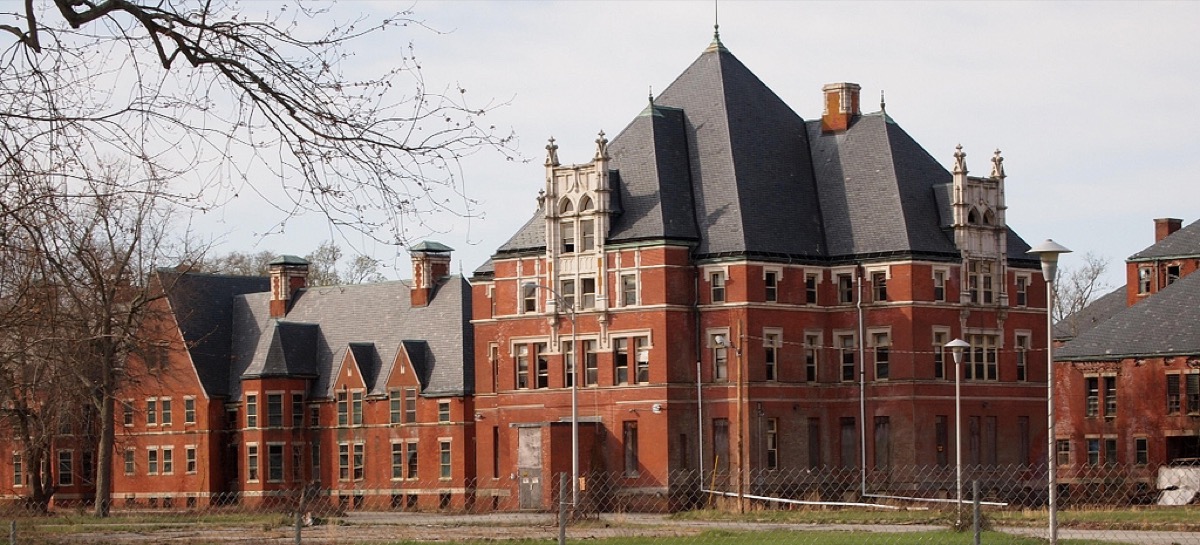
Norwich State Hospital for the Insane opened its doors in October 1904 on 172 acres of land along the Thames River in Preston, Connecticut—a site with deep historical roots. Jonathan Brewster had acquired this land as a gift from the Mohegan Tribe in 1650, using it as a farm and trading post. Two and a half centuries later, Connecticut built its second psychiatric institution here to relieve overcrowding at Middletown's asylum. The hospital began with 95 patients in a single building, but would grow into a sprawling, self-contained world.
By 1930, the patient population had swelled to 2,422 across twenty buildings. At its 1955 peak, 3,184 patients lived within over thirty structures connected by a warren of underground tunnels. The campus included its own power plant, bakery, farm with livestock, laboratory, theater, bowling alley, chapel, and staff housing. Each building was named after pioneers in mental health—Kirkbride, Dix, Salmon—lending an air of respectability to an institution that would become infamous.
The Salmon Building, named after Thomas W. Salmon, housed the maximum-security forensic unit for the criminally insane. With barred windows, steel doors, and prison-like cells, it confined some of Connecticut's most dangerous individuals—over 700 patients adjudicated "not guilty by reason of insanity." The facility's dark reputation stemmed not only from its population but from its treatments. Early superintendents believed in mechanical restraint over medication and employed controversial "water therapy." Patients were packed in ice, wrapped in sheet restraints, and subjected to prolonged solitary confinement.
From 1909 to 1963, the hospital performed 559 forced sterilizations under Connecticut's eugenics law—the second such statute passed in America. Vasectomies and ovariectomies were conducted on those deemed "defective" to prevent procreation. Later came electroconvulsive therapy, administered "inhumanely" according to nurse Judith A. Riley, who recalled patients not being properly anesthetized. Pre-frontal lobotomies were performed in the Abraham Ribicoff Research Center until, as one account noted, the hospital "only denounced lobotomies after many failed attempts on both adults and children."
Children were housed at Norwich—in the same building, just floors above extremely dangerous predators and killers. Unwed mothers, deemed "insane" to spare family shame, were confined here and not permitted to keep their children. Where those babies were sent remains unknown.
The 1939 Barker Commission investigation documented a facility 18% over capacity with inadequate medical records, irregular physical examinations, and just one physician per 200 patients—far below the required 1-to-150 ratio. State Senator Joseph B. Downes charged that food and clothing were inadequate, doctors incompetent, and staff insufficient. Though the hospital rebutted some findings, noting only 5 of 171 American state mental hospitals met staffing requirements, the damage to its reputation was done.
Death stalked Norwich's halls. In December 1914, lawyer Edward K. Arvine, admitted for "melancholia," hanged himself with torn bedclothes tied to an iron grating—the first documented misfortune of many. In September 1918, patient Solomon Brooks escaped and murdered his wife Rachel. A 1919 hot water heater explosion killed teamster Fred Ladd and night attendant Thomas Duggan. In 1934, Leonard Gosselin shot Sheriff Michael Carroll before turning the gun on himself, rather than face commitment. In 1941, patient William Smith died from a fatal overdose when an attendant mistakenly administered sedatives despite his heart condition. In August 1971, escaped patient Robert Layne killed two police officers in Spencer, Massachusetts. At least 13 documented deaths occurred by homicide, suicide, accident, or mysterious circumstances.
After 92 years, Norwich State Hospital closed on October 10, 1996, its remaining patients transferred to Connecticut Valley Hospital. The deinstitutionalization movement, combined with new patient-rights legislation and medical advances, had made such massive institutions obsolete. By the end, only two of the original buildings remained in use.
But those who entered the abandoned campus reported that something remained.
When nurses still worked the wards, they reported seeing children on the second floor—impossible, as no children were assigned there. Some heard screaming from the Salmon Building. Doors scraped open loudly, though the only entrance was on the first floor. After closure, security guards patrolling the empty grounds experienced even more disturbing encounters. One guard felt a hand brush his head while searching for intruders in an empty building. Others heard beeping sounds from the gutted lobotomy rooms, as if surgical equipment still operated. A woman's inconsolable sobbing echoes through empty corridors that haven't housed patients in decades.
In May 2010, Syfy's Ghost Hunters brought The Atlantic Paranormal Society (TAPS) to investigate. Co-founders Jason Hawes and Grant Wilson explored the Abraham Ribicoff Research Center, where lobotomies were performed and the morgue once stored the dead. They reported seeing a figure move from left to right at the end of a hallway, witnessed a light flash in a stairwell, and heard clear footsteps. In the patient rooms, investigators Britt Griffith and K.J. McCormick heard loud banging and observed a figure approximately three to four feet tall.
The most compelling evidence came from investigators Amy Bruni and Kris Williams in the morgue. During an EVP session, they witnessed a door open and close by itself. When they asked whatever presence existed to repeat the action, it did—followed by dragging sounds, all captured on videotape. The team described the number of EVP recordings as "out of control." They captured the sound of a dog whimpering, as if someone had kicked it. They heard animals crying and footsteps running down stairs in empty buildings.
The Salmon and Earle buildings proved especially active. In the Earle Building, heavy metal doors slammed with force suggesting a large, angry presence—yet no one was there. Tools fell from shelves. Orbs darted through open spaces. Shadow figures moved through corridors. Visitors reported sudden cold blasts even during hot summer days, electromagnetic pulses that set equipment haywire, and an overwhelming sense of being watched.
The underground tunnels, built for utilities and weather-protected patient transport, became a focus of paranormal claims. Urban explorers using the tunnels to avoid security reported rooms that were inexplicably colder than others. Some investigators claim patients were once chained in these tunnels and subjected to abuse and failed experiments, their anguished spirits still lingering in the darkness.
One visitor walking through a shadowy hallway got chills and heard someone shout "Get out of here!" very loud and close by—but when they looked around, no one was there.
In March 2018, the Mohegan Tribe—whose ancestors had originally gifted this land to Jonathan Brewster nearly 400 years earlier—returned to cleanse it. On March 1, Chief Lynn "Many Hearts" Malerba lit a ceremonial fire that would burn for four days, the smoke meant to cleanse the land and the spirits of all who had passed through it. Approximately thirty attendees made tobacco offerings at each cardinal direction, honoring deceased relatives and acknowledging the trauma this place had witnessed. The tribe planned to light cleansing fires each season until development began.
Today, most of the original buildings have been demolished, though the administration building and a few structures remain. The grounds are closed to public access, actively patrolled, and undergoing redevelopment as the Preston Riverwalk. Recent structural fires in July and October 2025 have intensified safety enforcement. But for those who believe, the spirits of Norwich State Hospital—the children glimpsed on the second floor, the sobbing woman, the figures in the tunnels—are not so easily displaced. Nearly a century of suffering, confinement, and death may have left an imprint that no cleansing fire can fully erase.
Researched from 15 verified sources including historical records, local archives, and paranormal research organizations. Learn about our research process.