
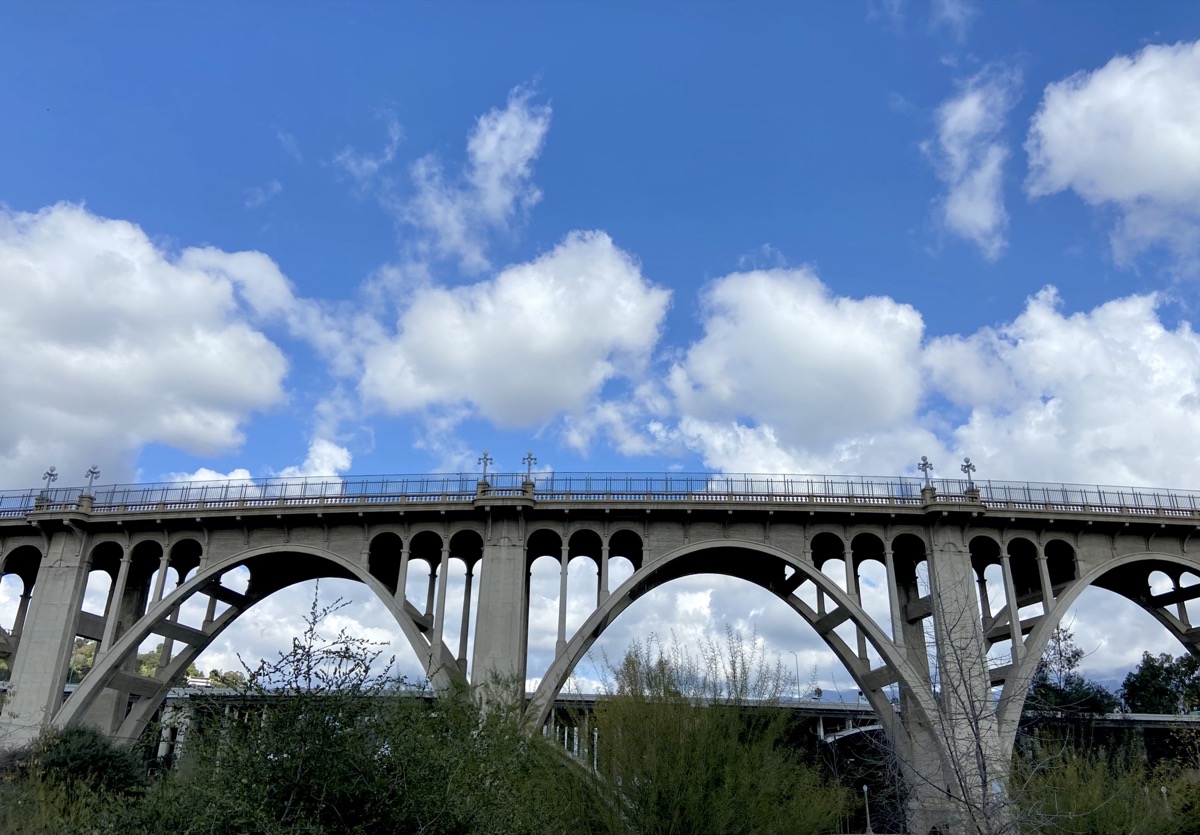
About This Location
This majestic 1913 bridge spans the Arroyo Seco canyon at 150 feet - when completed, it was considered the highest concrete bridge in the world. By 1932, it had earned a sinister name: Suicide Bridge. More than 150 people have ended their lives here, with around 50 occurring during the Great Depression. The bridge was once part of Route 66 and is now a Civil Engineering Landmark on the National Register of Historic Places. A suicide barrier was added in 1993.
The Ghost Story
The Colorado Street Bridge opened on December 13, 1913, after 18 months of construction using 11,000 cubic yards of concrete and 600 tons of reinforcing steel. Designed by Waddell & Harrington at a cost of $191,000, the 1,467-foot span rises 150 feet above the Arroyo Seco canyon—at completion, the highest concrete bridge in the world. It became part of Route 66 from 1936 to 1940 and appeared in Charlie Chaplin's 1921 film "The Kid." But tragedy marked the bridge before it was even finished.
Legend holds that during construction, a worker toppled over the side and plunged headfirst into a vat of wet concrete. His coworkers, assuming he couldn't be saved in time, left his body entombed in the quick-drying cement. Some believe his spirit draws troubled souls to the bridge, while others claim to see a boots-clad construction worker walking the span.
The first recorded suicide came on November 16, 1919. Within a decade, locals had renamed it "Suicide Bridge." By 1937, 87 people had leapt to their deaths. The Great Depression proved especially devastating—nearly 50 of the bridge's suicides occurred between 1933 and 1937, as despondent bankers, jobless workers, and broken families sought a final exit.
The most infamous incident occurred at 9 AM on May 1, 1937, when 22-year-old Myrtle Ward of El Sereno walked toward the center of the bridge, clutching her three-year-old daughter Jeanette. As horrified onlookers watched, she threw the child over the railing, then jumped herself. Myrtle died on impact—but Jeanette miraculously survived. The thick wool coat Myrtle had wrapped around her daughter snagged on tree branches, slowing her descent until she landed safely in the foliage below.
Fifty-five years later, Jeanette Pykkonen returned for the bridge's 1993 reopening ceremony. "It just welled up in me that this was a mother full of love," she told reporters. "She thought there was no hope and she didn't want to leave her child to suffer in this world." The city had just completed a $27 million renovation, adding eight-foot suicide barriers—yet Myrtle's ghost is said to still roam the bridge, searching for her daughter.
The paranormal activity reported here is relentless. A spectral woman in a flowing robe stands atop the parapets, then leaps to her death—only to vanish before hitting the ground. A man in wire-rimmed glasses walks the bridge at night. Another specter approaches visitors and whispers "It's her fault," but never explains who "she" is. A headless figure in black clothing has been spotted near the arches.
In the arroyo below, phantom forms walk the dry riverbed. Homeless individuals camping under the bridge regularly report seeing ghostly figures and hearing mysterious noises—unexplained cries echoing through the canyon, the clop of hooves from a phantom horse-drawn carriage, metal-on-metal sounds like jangling jewelry. The atmosphere is described as "thick" with despair.
Paranormal investigators have captured disturbing EVPs here. One female voice responded to questions about why someone jumped by saying, "It's a bridge, it's the perfect place to go." Other recordings captured whispered commands—"jump," "do it"—along with desperate pleas of "save me," "help me," and "I'm sorry." Around 10 PM, investigators commonly hear a female voice command "quiet." Visitors report sudden temperature drops, flickering lights, eerie vibrations, and the sensation of being touched by unseen hands.
More than 150 people have now ended their lives here, including British-American model Sam Sarpong on October 27, 2015. A wave of 28 deaths occurred between 2006 and 2016. Despite ten-foot temporary fencing installed in 2016, nine more died in 2017, with four additional deaths by September 2018.
The bridge earned Civil Engineering Landmark status and a place on the National Register of Historic Places. It was featured in F. Scott Fitzgerald's "The Last Tycoon," Lana Del Rey's "Summertime Sadness" music video (2012), and the Oscar-winning "La La Land" (2016). But for those who cross after dark, the accolades matter less than the shadows—Depression-era bankers, despondent mothers, and over a century of sorrow still walking the span, still searching for something they lost on the way down.
Researched from 10 verified sources including historical records, local archives, and paranormal research organizations. Learn about our research process.